Quantum engines enter the real world: Tiny superconducting device could build computers of the future
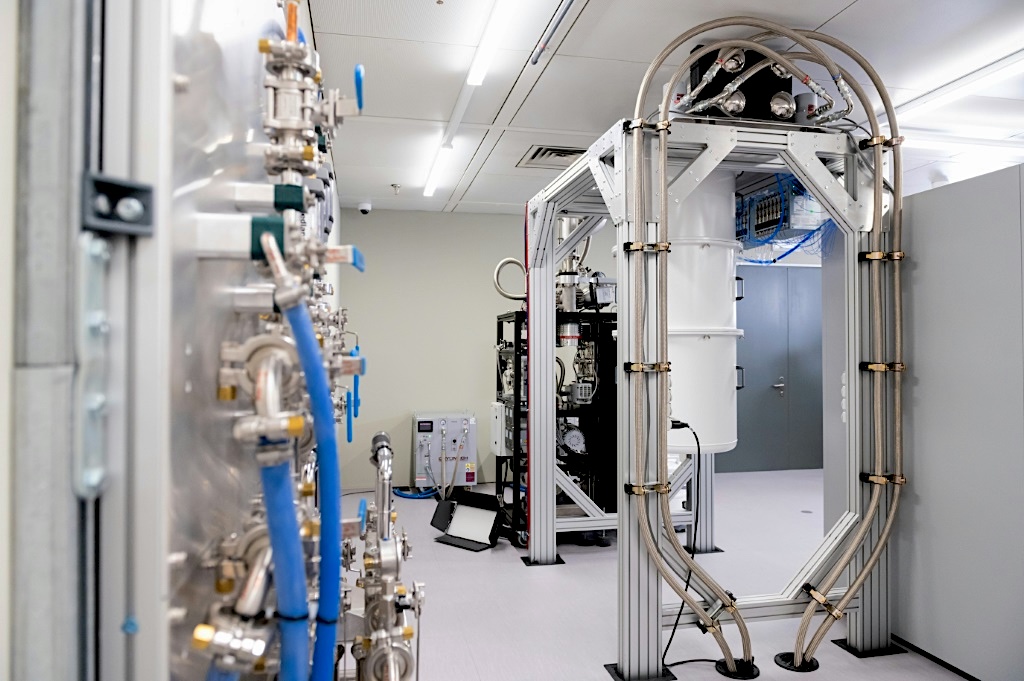
Scientists at Finland’s Aalto University have successfully built and operated the world’s first cyclic superconducting quantum heat engine, a device that converts tiny amounts of heat near absolute zero into useful work. The achievement provides a rare experimental bridge between quantum mechanics and thermodynamics, two branches of physics that traditionally describe very different worlds. Beyond its initial scientific significance, the breakthrough could eventually help solve one of the biggest engineering challenges facing large-scale quantum computing.
Thermodynamics governs the familiar world of heat, energy transfer, and engines. It explains how power stations generate electricity, how refrigerators cool food, and how vehicle engines convert fuel into motion. Quantum mechanics, by contrast, describes the strange behaviour of particles at atomic and subatomic scales, where phenomena such as superposition, tunnelling, and entanglement dominate.
For decades, physicists have been fascinated by the overlap between these two fields. A central question has been whether the familiar principles of heat engines still apply when the working components themselves obey quantum rules. The Aalto University experiment moves that question from theory into practice. Researchers created a functioning heat engine inside a superconducting circuit and demonstrated that it could repeatedly convert heat into positive work through a complete thermodynamic cycle.
The research team implemented an Otto cycle, the same thermodynamic process that powers many conventional car engines. Instead of pistons and fuel, however, the quantum version relies on superconducting electronic components operating at temperatures close to absolute zero.
The Otto cycle is an idealised thermodynamic cycle that models the operation of spark-ignition engines, converting heat from fuel into mechanical work through a sequence of compression, combustion, expansion, and exhaust processes.
At the centre of the system is a transmon qubit, one of the most widely used building blocks in contemporary quantum computers. The qubit is combined with a resonator and a quantum-circuit refrigerator, creating a complete quantum heat engine. Lead author Tuomas Uusnäkki explained that the device was fabricated using superconducting circuits and operated inside a cryostat, an ultra-cold environment capable of reaching temperatures near absolute zero. The transmon qubit served as the working medium that absorbed and released heat during the engine cycle.
How the engine works
Conventional heat engines require separate hot and cold reservoirs. The Aalto design takes a different approach. Researchers connected the transmon qubit to a quantum-circuit refrigerator capable of providing both heating and cooling. By carefully controlling the refrigerator and applying timed pulses, the team guided the qubit through repeated thermodynamic cycles. Measurements demonstrated that heat flowing through the system was successfully converted into measurable work.
This may sound incremental, but in the field of quantum thermodynamics it represents a major milestone. Scientists have long sought experimental demonstrations of cyclic quantum heat engines, yet achieving reliable and repeatable operation has proven challenging. The results provide strong evidence that quantum heat engines can be engineered and controlled using superconducting circuit technologies already familiar to quantum computing researchers.
Why quantum computing could benefit
The implications go well beyond fundamental physics. Today’s quantum computers require extensive infrastructure to function. Superconducting quantum processors operate at temperatures only fractions of a degree above absolute zero and must be connected to room-temperature electronics through large numbers of microwave cables. These connections are expensive, bulky, and introduce unwanted noise into the system.
The superconducting quantum heat engine is not itself a “manager,” but it represents the type of autonomous cryogenic component that could eventually reduce the need for vast numbers of control lines.
Cryogenics is absolutely central to most modern quantum computers. In simple terms, cryogenics provides the ultra-cold environment needed for quantum bits to function reliably. Without extreme cooling, many leading quantum computing technologies would not work at all. At room temperature, these thermal fluctuations overwhelm the delicate quantum effects needed for computation. Cooling the system dramatically reduces this unwanted activity and allows qubits to maintain their quantum states for longer periods.
As quantum computers scale upward, the challenge becomes greater. Academy Professor Mikko Möttönen notes that Finland’s national quantum technology strategy includes ambitions for quantum computers containing 1,000 logical qubits by 2035. Achieving that goal could require hundreds of thousands of physical qubits, potentially demanding millions of microwave connections using current architectures.
Autonomous quantum devices such as heat engines could one day operate directly within cryogenic systems, reducing reliance on external cabling. Such an approach could simultaneously lower hardware costs and reduce noise that interferes with fragile quantum states.
Researchers have spent decades asking whether classical thermodynamic ideas survive within quantum systems. By demonstrating a functioning superconducting quantum heat engine, the Aalto team has shown that familiar concepts such as heat, work, and engine cycles can indeed be realised within quantum hardware. That result not only advances quantum engineering but also deepens our understanding of nature itself.
Quantum engines enter the real world: Tiny superconducting device could build computers of the future
#Quantum #engines #enter #real #world #Tiny #superconducting #device #build #computers #future