The work beneath our feet: What it takes to deliver water, power, and gas to communities
Opinions expressed by Digital Journal contributors are their own.
Every day, millions of people turn on a faucet, switch on a light, or heat their homes without thinking about the infrastructure that makes it possible. Behind every utility connection is a vast underground network of pipelines and transmission systems that takes years of planning, engineering, and skilled construction to build. W.A. Rasic Construction explains what it truly takes to deliver the essential water, power, and gas infrastructure that communities rely on every day.
Essential utilities begin long before construction starts
By the time construction crews arrive, months or even years of planning have already taken place. The process begins with identifying the need for new or upgraded infrastructure, after which engineers design a solution that meets technical requirements while accounting for the surrounding environment and existing infrastructure.
Extensive surveying and utility locating follow to map roads, buildings, pipelines, electrical lines, telecommunications systems, and other underground assets. Environmental reviews, permits, and approvals are then completed, alongside traffic management and safety planning, to ensure construction can proceed safely, efficiently, and with minimal disruption to surrounding communities.
Building underground infrastructure is more complex than it appears
Existing infrastructure and congested environments
Most underground utility work takes place beneath busy cities that never stop operating. Crews must build new pipelines around existing water, gas, electrical, telecommunications, and sewer infrastructure while keeping roads, businesses, and public transportation functioning.
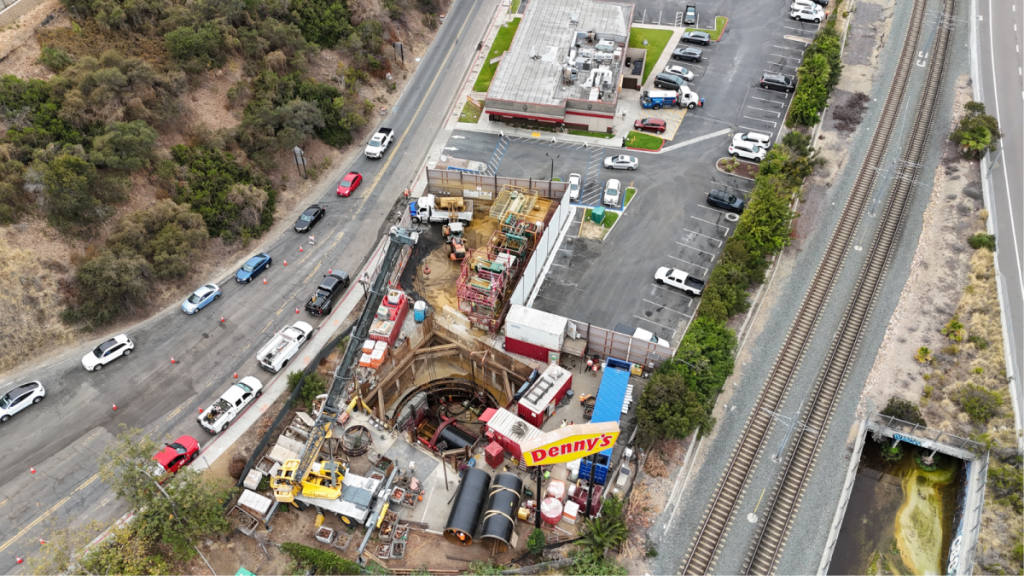
On W.A. Rasic Construction’s Montezuma Mid-City Pipeline project, crews are installing more than a mile of 66-inch transmission pipeline through heavily congested corridors, with portions of the line constructed beneath Metro transit tracks and Highway 8.
Working within these confined spaces requires detailed planning, specialized equipment, and construction methods that minimize disruption above ground.
Every site presents unique engineering challenges
No two underground infrastructure projects are the same. Soil conditions, existing utilities, available workspace, traffic patterns, and nearby buildings all influence how construction is carried out.
At the Montezuma Mid-City Pipeline project, crews are working from excavations more than 50 feet deep in a constrained site adjacent to active businesses and transit infrastructure.
In situations like these, trenchless methods such as microtunneling allow pipelines to be installed beneath roads and rail lines while limiting impacts on the surface.
Construction must continue while communities keep moving
Unlike many construction projects, underground utility work cannot simply close down the surrounding area. Crews must build essential infrastructure while people continue driving to work, businesses remain open, and public transit operates on schedule. That’s why projects are carefully staged, with activities such as night work helping reduce traffic disruption.
On the Montezuma Mid-City Pipeline project, W.A. Rasic Construction is installing more than a mile of 66-inch transmission pipeline through one of San Diego’s busiest corridors while maintaining access for surrounding businesses and transportation systems.
Every underground project requires constant problem solving
Even with detailed planning, underground construction always involves uncertainty. Existing utility records may be incomplete, soil and weather conditions can change unexpectedly, groundwater may be encountered, and previously unknown utilities can be uncovered once excavation begins.
As W. A. Rasic’s division manager, Anthony Aguilar, explained, “We do not know what is in the ground until it is opened up. Even the best utility maps are often wrong.”
Because of these unknowns, construction teams must continually assess conditions and adapt their approach while maintaining safety, protecting existing infrastructure, and keeping the project on schedule. This is where experienced field leadership becomes invaluable, combining technical expertise with real-time decision-making to solve problems as they arise.
Precision and safety drive every decision
Underground utility construction relies on engineering precision as much as physical labor. Every stage of the work is carefully monitored to protect workers, the public, existing infrastructure, and the integrity of the project itself.
On the Montezuma Mid-City Pipeline project, crews continuously monitored tunnel boring machine (TBM) face pressure and jacking forces throughout tunneling operations. Heavy equipment movements, critical crane lifts, excavation protection systems, and mud recycling operations also had to be carefully coordinated to keep work progressing safely and efficiently.
This constant attention to detail allows construction teams to manage complex underground operations while maintaining the safety and reliability of the essential infrastructure being built.
Skilled trades keep communities running
Behind every utility project is a team of skilled professionals working together to deliver critical infrastructure. Operators, laborers, pipefitters, welders, superintendents, engineers, surveyors, and safety professionals each play a vital role in keeping projects moving safely and efficiently.
Experience is essential in underground construction, where changing site conditions and complex technical challenges require sound judgment and teamwork. Success depends on collaboration across multiple disciplines, with every member of the project contributing to the final outcome.
Reflecting on the people behind this work, Anthony Aguilar summed it up simply: “Praise the Trades.” It’s a recognition that while much of their work remains unseen beneath the ground, the infrastructure they build keeps communities running every day.
The infrastructure we depend on every day
Every time someone turns on a faucet, powers a business, heats a home, or cooks dinner, they’re relying on infrastructure that required years of planning, engineering, and the expertise of skilled professionals working below ground.
Much of this work is never seen, but its impact is felt every day. Companies like W.A. Rasic Construction build and maintain the underground systems that deliver essential water, power, and gas safely and reliably, helping communities and businesses operate with confidence.
About W.A.Rasic Construction
For more than 45 years, W.A. Rasic Construction Company has been a trusted leader in infrastructure development, known for its commitment to safety, quality, and reliable project delivery. W.A. Rasic specializes in underground utilities, water, wastewater, power, communication, gas and oil, and heavy civil construction, serving public and private sector clients across the Western United States.
The work beneath our feet: What it takes to deliver water, power, and gas to communities
#work #beneath #feet #takes #deliver #water #power #gas #communities