Sovereign AI: Why Canada’s next technology challenge is infrastructure

Much of the public conversation around AI still focuses on models, chatbots, funding rounds, and headline-grabbing breakthroughs. Yet the next phase of AI competition may depend on less visible assets: power generation, GPU capacity, networking infrastructure, cooling technologies, and data centre development. The countries that successfully integrate research excellence with large-scale domestic compute infrastructure are likely to enjoy a significant advantage in commercializing AI innovation. This includes Canada.
Canada has earned a global reputation as an artificial intelligence powerhouse. The country helped pioneer modern machine learning through the work of researchers such as Geoffrey Hinton and Yoshua Bengio, while institutions like the University of Toronto, the Vector Institute, Mila, and the University of Waterloo continue to produce world-class AI talent. Yet as the global AI race accelerates, a new reality is emerging: talent alone is no longer enough.
The next phase of competition will be determined not simply by who develops the best AI models, but by who owns and controls the infrastructure needed to train, deploy, and scale them. Increasingly, governments and enterprises are recognizing that AI sovereignty depends upon compute sovereignty. This is why the decision by HIVE Digital Technologies to develop a planned 320-megawatt AI factory in the Greater Toronto Area represents more than a data centre investment. It is part of a growing movement toward sovereign AI infrastructure.
The rise of sovereign AI
For much of the past decade, organizations could rely on global cloud providers to process data and support digital transformation initiatives. AI, however, is changing the equation. Large language models, foundation models, agentic AI systems, and advanced analytics require vast amounts of computational power. Training and operating these systems increasingly demands access to specialized hardware, particularly high-performance graphics processing units (GPUs). The location of that infrastructure is becoming strategically important.
For sectors such as healthcare, finance, defence, life sciences, and public administration, data concerns are no longer theoretical. Organisations increasingly want assurance that both their data and AI workloads remain within national borders. As a result, sovereign AI has become a strategic priority across Europe, Asia, and North America. The concept goes beyond software. It encompasses domestically controlled compute resources, secure data storage, trusted supply chains, and national digital resilience.
Canada’s infrastructure gap
Canada has helped invent many of the technologies underpinning today’s AI revolution. Canadian universities consistently rank among the world’s leading centres for AI research. Canadian startups continue to attract global investment, while companies such as Cohere, Waabi, and Xanadu demonstrate the country’s innovation potential. However, critics have increasingly pointed to a mismatch between Canada’s research leadership and its compute capacity. Many Canadian organizations continue to rely heavily on infrastructure located outside the country, particularly in the United States. This creates potential challenges around data governance, latency, security, and long-term technological independence. In other words, Canada has developed world-class AI talent but has not always possessed sufficient domestic infrastructure to fully capitalize on it. That challenge is becoming more visible as AI adoption moves from experimentation into production-scale deployment.
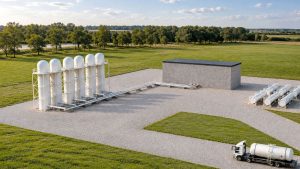
Against this backdrop, HIVE Digital Technologies has unveiled plans for what could become one of Canada’s largest AI-focused infrastructure projects. Through its subsidiary BUZZ High Performance Computing, HIVE is developing plans for an industrial-scale AI facility within the Greater Toronto Area supported by approximately 320 MW of utility capacity. The site is expected to support more than 100,000 GPUs at full build-out, creating a major hub for AI training and inference.
The project is strategically located within the Toronto-Waterloo innovation corridor, one of Canada’s most significant technology regions. Positioned between the University of Toronto ecosystem, the Vector Institute, and Waterloo’s engineering talent base, the facility sits at the intersection of research excellence, enterprise demand, venture capital, and startup innovation. According to HIVE, the facility is intended to support enterprise, research, and public-sector AI applications while providing domestic compute resources capable of supporting large-scale Canadian AI development.
Compute as a strategic asset
The idea that compute infrastructure could become a national strategic asset may have seemed unusual only a few years ago. AI models are increasingly viewed as critical economic infrastructure. The organizations capable of controlling large-scale compute resources gain advantages in innovation, productivity, research, and economic competitiveness. Countries that depend entirely on external infrastructure providers may find themselves constrained in how quickly they can develop and deploy advanced AI systems. This is relevant given the extraordinary demand for GPU-based computing resources. Access to advanced AI hardware has become one of the major bottlenecks facing companies seeking to build new AI products and services. The availability of domestic compute resources can therefore influence where companies choose to invest, scale operations, and commercialize technologies.
The Toronto project is not an isolated initiative. HIVE has increasingly positioned itself around a broader sovereign AI infrastructure strategy that spans multiple jurisdictions. The company has emphasized secure and domestically controlled infrastructure across several markets, reflecting a wider trend in which nations seek greater ownership of digital infrastructure supporting critical workloads.
The strategy mirrors developments occurring across Europe, where governments are investing heavily in regional cloud and AI infrastructure to reduce dependence on foreign hyperscale providers. Similar discussions are underway in Asia-Pacific jurisdictions as nations assess how AI infrastructure fits within broader economic and national security objectives. In this context, Canada’s investment in sovereign compute capacity is not simply about supporting local startups. It is about ensuring that Canadian organizations retain access to strategic infrastructure as AI becomes increasingly central to economic growth.
Sovereign AI: Why Canada’s next technology challenge is infrastructure
#Sovereign #Canadas #technology #challenge #infrastructure