Patient-specific orthopedics puts speed alongside precision
This article has been reviewed by a Digital Journal editor and may be licensed for reuse.
Patient-specific orthopedic solutions appear to be gaining attention as additive manufacturing becomes more established in healthcare. Fortune Business Insights values the global healthcare 3D printing market at $12.19 billion in 2025 and projects it could reach $57.49 billion by 2034. Its analysis identifies customized implants and patient-specific healthcare solutions among the factors supporting market development, with medical implants representing about 58% of the application segment.
The technology may carry particular relevance in cases where anatomy, injury pattern, or bone loss creates requirements that a standard device may not readily accommodate. That consideration also introduces a question: How efficiently can a customized design move from digital planning through manufacturing and into clinical use? For elective procedures, production timelines may be incorporated into surgical planning. Trauma can create a different set of requirements, where the availability of definitive fixation can become part of the treatment equation.
Research into staged fixation illustrates why timing can matter clinically. A study indexed by the National Library of Medicine followed 55 patients with open tibial fractures who initially received temporary external fixation. Infection occurred in 12.8% of patients converted within 12 days, compared with 18.2%, 50%, and 100% across groups with longer conversion intervals.
Manufacturing strategy adds another consideration. Fortune Business Insights estimated the global medical device contract manufacturing market at $87.43 billion in 2025, describing growing activity across design support, component manufacturing, testing, packaging, and other stages of device development. Its analysis also identifies regional manufacturing, supplier integration, and engineering capabilities as factors companies may consider when managing increasingly complex supply chains. Within patient-specific orthopedics, those capabilities can influence how closely design, production, quality processes, and delivery connect.
Within this landscape, Kevin Brothen, U.S. President at Ortho Solutions Group, sees speed as an important dimension of personalization. The company is a specialist foot and ankle orthopedic business that works with surgeons on implant and instrumentation development, including patient-specific solutions. “The disruption will be speed to delivery,” Brothen states. His observation points toward a broader question for additive manufacturing: whether customization can become clinically practical when production is sufficiently responsive to the circumstances of an individual case.
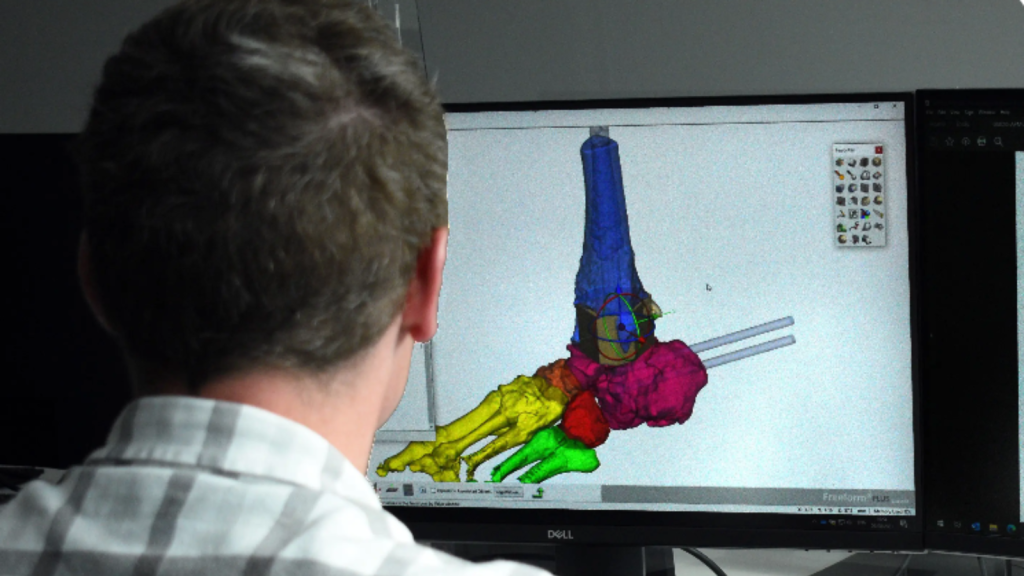
That principle informs a three-part model within the company’s work: design based on the patient’s anatomy and injury, development informed by the surgeon’s clinical requirements, and delivery of the resulting solution within the timeframe the case requires. Its OrthoMatrix platform, for example, includes patient-specific, 3D-printed fusion cages and total talus implants for significant bone loss in foot and ankle procedures. Maintaining design and manufacturing capabilities internally forms part of the company’s strategy, allowing engineering, production, and clinical feedback to remain connected through the development process.
The role of surgeon collaboration becomes particularly important in that structure. Brothen describes feedback from surgeons and key opinion leaders as a major source of information for determining which clinical problems merit product development. “Every patient is different, so one standardized solution cannot necessarily serve everyone,” he remarks. That perspective places customization within a clinical context: the purpose of a device can begin with a specific anatomical or surgical requirement, with engineering then translating that requirement into a manufacturable solution.
Evidence provides another filter for product development. Rather than treating innovation as an exercise in expanding a catalog, the company places emphasis on clinical classifications and defined indications. Brothen points to the development of its ankle fracture system around the Mason-Malloy classification, alongside evidence based medicine, as an example of this principle. The classification provides a framework for understanding fracture patterns, while surgeon input can help connect those patterns to practical fixation requirements.
That specialization also reflects a deliberate focus on foot and ankle surgery. Orthopedics encompasses a wide range of anatomical regions and procedures, while the company concentrates its engineering and commercial activity on the lower extremity. Such a narrow clinical scope may give teams more opportunity to accumulate knowledge around specific procedures, fixation challenges, and reconstruction requirements. OrthoMatrix extends that focus into complex reconstruction, while conventional plates, screws, nails, and other systems address a broader range of foot and ankle procedures.
“Our U.S. engineering and manufacturing setup ties directly into the broader supply chain strategy,” Brothen explains. “When medical device companies choose suppliers, they often weigh technical capabilities, quality standards, location, and turnaround times. Having in-house manufacturing is simply one way a specialized company can structure its product development.” For Ortho Solutions, that structure also creates a setting for further patient-specific development and additional technologies, including products addressing complex trauma and limb-salvage applications.
Brothen’s perspective ultimately links commercial activity with future product development. “The sales of today are going to drive the innovation of tomorrow,” he states. “It’s a cycle in which resources generated through current products can support engineering, clinical collaboration, and new solutions.” Within a consolidating medtech environment, specialization, evidence, customization, surgeon relationships, and manufacturing capability may provide several dimensions through which smaller and midsize organizations can define their role.
The broader trajectory of orthopedic innovation may increasingly involve the ability to identify the appropriate solution for an individual clinical problem and develop it within a practical delivery framework. Patient-specific manufacturing gives that idea a technological foundation, while clinical evidence and surgeon collaboration provide context for its use.
As additive manufacturing develops, personalization may become more consequential when it can be delivered with the speed and evidence clinicians expect. For orthopedic care, the emerging question may be about connecting anatomy, clinical need, engineering, and timely delivery in a single development process.
Patient-specific orthopedics puts speed alongside precision
#Patientspecific #orthopedics #puts #speed #precision