Canada Rocket Company to build first large-scale engine test site
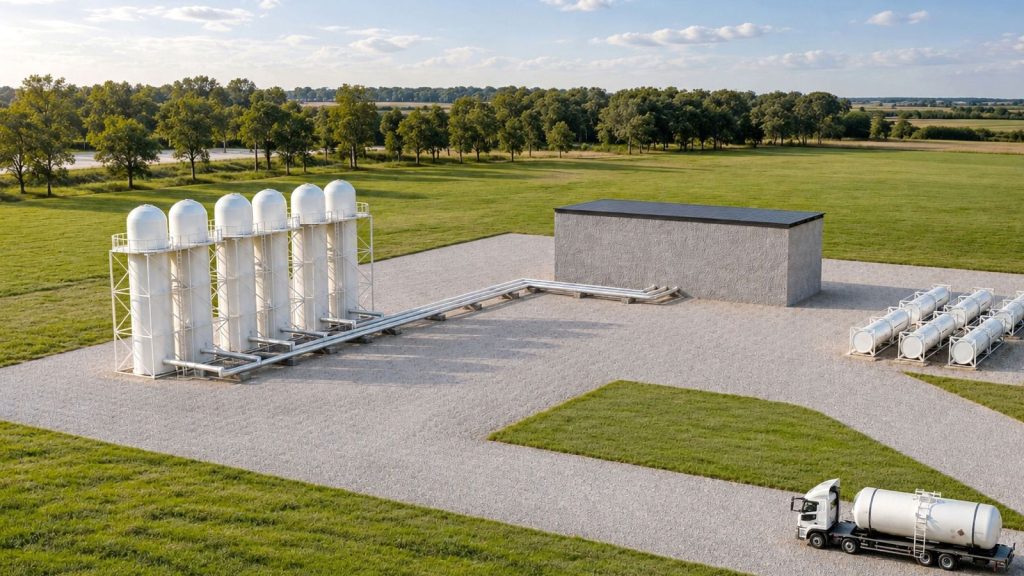
Canada Rocket Company is building Canada’s first large-scale rocket engine test facility in London, Ontario. The company says the $30-million site will let it conduct static testing of the rocket engines it is developing, which it describes as a foundational step toward Canadian launch capability.
The Jeremy Hansen Test Facility, named after the astronaut who this year became the first Canadian to travel to the Moon, will sit on 50 acres leased from the Greater London International Airport Authority. It includes a 12,000-square-foot office and fabrication building and an engine test area with up to three stands for static-firing large rocket engines.
Static engine testing means firing an engine while it is held in place on the ground, so the company can measure how it performs and fix problems before the engine goes on a rocket. Canada Rocket Company also has a 7,600-square-foot engine development shop in Toronto, and the London site will let it test larger engines at full scale.

“This is the first large-scale static rocket engine test facility in Canada, capable of testing engines producing more than 1MN in thrust. With it, Canada joins a small group of less than 10 countries worldwide with this capability,” said Hugh Kolias, CEO and co-founder of Canada Rocket Company.
Jeremy Hansen, a London native who flew around the Moon on Artemis II in April, backed the case for building launch capability in Canada.
“Missions like Artemis II depend on a strong national space sector, and sovereign launch is an important part of Canada’s future. Canada Rocket Company is helping build that capability here at home,” said Hansen.
The company expects to create about 40 jobs at the London site within 18 months. From there, it projects that the broader rocket program the facility supports will create roughly 1,000 jobs and more than $1 billion in investment over the next decade.
Kolias has said that developing Canada’s launch capability will take about $500 million over eight years, and he has described the work as more a matter of capital than engineering. The company is building training partnerships with Western University and Fanshawe College to grow the technical workforce it will need.

Canada builds satellites but can’t launch them
Canada has built satellites for decades but has never had its own way to launch them, so Canadian satellites reach orbit on rockets owned and operated by other countries. Kolias has argued that this leaves Canada dependent on other nations to decide when, and whether, its satellites get to space.
The company notes that space infrastructure supports everyday services including GPS, telecommunications, weather forecasting and national defence. Getting any of it to orbit depends on access to a rocket, and that is the capability Canada Rocket Company is trying to build at home.
The federal government has made sovereign launch a priority, naming space a high-value sector in its 2026 Defence Industrial Strategy and awarding Canada Rocket Company and two other companies $8.3 million each through the Department of National Defence’s Launch the North challenge, run under its IDEaS program. NordSpace and Reaction Dynamics received the other two awards.

Canada Rocket Company came out of stealth in January and has raised about $22.5 million. It is building its vehicle around the E-1, its own methalox engine, and is targeting the medium-lift market, with a rocket the company says will carry up to 12,500 kg to Sun Synchronous Orbit.
The company has recruited senior engineers from SpaceX, Blue Origin, Rocket Lab and ArianeGroup, including co-founder and chief technology officer David Tenny, who spent nearly a decade at SpaceX working on the Merlin engine that powers Falcon 9.
The company says it will hold a public consultation in October to answer questions about the development, with details to come. The rocket Canada Rocket Company is building is still years from a launch pad, and the company expects the London site to be fully operational in 2028.
Canada Rocket Company to build first large-scale engine test site
#Canada #Rocket #Company #build #largescale #engine #test #site