
Magnetic vortices caught ‘melting’ could point to brain-like computers
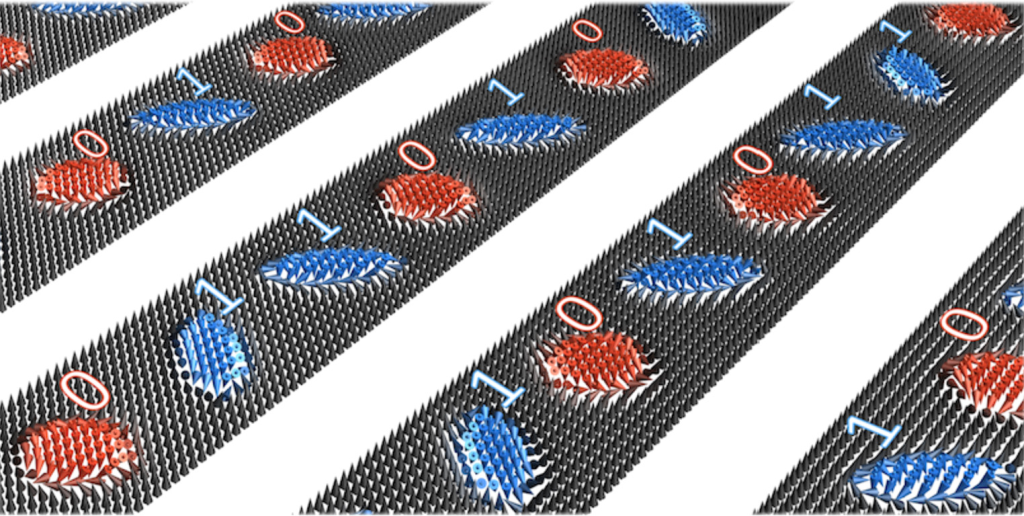
The search for computers that can process increasing quantities of information without a corresponding surge in energy consumption is pushing scientists beyond conventional semiconductor designs. One candidate is extraordinarily small, inherently magnetic and capable of behaving rather differently from the bits used by today’s computers.
These structures are known as magnetic skyrmions, nanoscale whirlpools of magnetisation that can form within certain magnetic materials. Their small size, stability and ability to be manipulated have made them attractive candidates for future memory, logic and neuromorphic computing technologies.
Now researchers have gained a particularly revealing view of how skyrmions behave collectively. Scientists have observed, in real time, the process by which an ordered lattice of skyrmions loses its structure and effectively ‘melts’.
The research is described in the peer-reviewed journal Nature Nanotechnology in the study Real-time observation of topological defect dynamics mediating two-dimensional skyrmion lattice melting, by Raphael Gruber and colleagues. The paper reports direct observations of the defect dynamics that govern the melting process in a two-dimensional skyrmion lattice. The work could ultimately help researchers develop devices in which information is represented and manipulated through magnetic states rather than relying solely on conventional electrical architectures.
What exactly is a skyrmion?
A skyrmion is not a physical particle in the ordinary sense. Rather, it is a stable configuration of spins in a magnetic material. The spins twist through space so that the overall structure resembles a tiny vortex. What makes this particularly interesting for computing is the structure’s topological character. In simplified terms, the magnetic configuration has a degree of robustness because changing it into a fundamentally different state requires reorganising the spins.
Skyrmions are being investigated within spintronics, a field that seeks to exploit an electron’s spin and associated magnetic properties alongside, or instead of, its electrical charge. This opens the possibility of storing information in extremely small magnetic structures and potentially moving or manipulating that information with comparatively low energy requirements.
Spintronics, which stands for “spin transport electronics” is a branch of electronics that exploits the intrinsic spin of the electrons and their fundamental electronic charge for the various functionalities in solid-state devices.
Modern computing faces a persistent problem in the relationship between processing power, data movement and energy consumption. As artificial intelligence systems become larger, reducing the energy cost of computation is becoming increasingly important. Brain-inspired, or neuromorphic, hardware is one proposed solution. Instead of simply making existing processor architectures faster, neuromorphic designs attempt to reproduce useful features of biological information processing.
Digital Journal has previously reported on another strand of this research, involving a cerebellum-inspired electronic device designed to process information more selectively and reduce unnecessary computation. That research illustrates the wider move towards hardware that performs computation differently rather than merely scaling conventional processors.
Watching a magnetic crystal lose its order
Skyrmions become especially interesting when they interact. Under suitable conditions, they can arrange themselves into regular two-dimensional lattices. The result is somewhat analogous to atoms forming an ordered crystal, except the repeating components are magnetic textures. Understanding how this ordered state breaks down is important both for fundamental physics and for engineering devices based on skyrmions.
The research team has now been able to watch this transition in real time while observing the behaviour of individual skyrmions. In the experiment, the transition from an ordered skyrmion lattice to a disordered state was mediated by topological defects within the lattice. This makes the research relevant to a much wider question in condensed-matter physics: how two-dimensional systems undergo phase transitions.
For computing applications, the significance is more practical. A technology based on skyrmions requires engineers to understand not only how to create and move the structures but how they interact, reorganise and remain stable when operating conditions change. The finer the control scientists can achieve over an individual skyrmion’s position, dimensions and interactions with neighbouring skyrmions, the more realistic it becomes to consider these structures as functional elements of future information-processing systems.
One of the study’s researchers, Asle Sudbø of the Norwegian University of Science and Technology (NTNU), has highlighted the potential implications for brain-inspired computing. “Skyrmions are small, magnetic vortices that can store information in a completely new way,” Sudbø explained in material accompanying the research.
The attraction extends beyond simply making a smaller magnetic memory. Biological brains are extraordinarily energy-efficient compared with conventional computing systems when tackling tasks such as sensory processing, adaptation and pattern recognition. This has driven growing interest in neuromorphic computing, in which hardware itself can mimic some of the dynamic behaviours found in neural systems.
Networks of interacting skyrmions are intriguing in this context because their magnetic states can respond collectively to physical stimuli. Instead of enforcing every computing operation through conventional transistor-based Boolean logic, researchers can explore whether the evolving physical state of magnetic systems can itself perform useful computation. This does not mean that a skyrmion ‘thinks’ like a neuron, nor that skyrmion computers are close to replacing silicon processors. The more defensible expectation is that their unusual dynamics could be exploited within specialised computing architectures.
Why lower-energy computing matters
Energy efficiency is becoming an increasingly important constraint on computing. Artificial intelligence has placed particular pressure on the traditional relationship between memory and processing. Conventional architectures frequently require information to be moved between memory and processors, and that data movement itself consumes energy.
Emerging approaches including spintronics, memristive devices and neuromorphic processors seek to reduce some of this burden by changing where and how computation occurs. Skyrmions could contribute to this transition because magnetic information can potentially be manipulated at very small scales. Their possible applications include high-density memory, unconventional logic and hardware capable of exploiting interacting physical states for computation.
The idea belongs to a wider effort to redesign computing at the physical level. Another emerging branch concerns quantum information systems. As Digital Journal has previously reported, researchers are also investigating artificial structures such as ‘giant superatoms’ as means of protecting and controlling quantum information. Skyrmions do not provide a simple bridge to a general-purpose quantum computer, but their topology makes them scientifically relevant to research into unusual magnetic and quantum phenomena.
There remains, however, a considerable distance between filming skyrmions in a laboratory and incorporating millions or billions of reliable magnetic elements into commercial computing systems. Practical devices would need methods for reproducibly creating, detecting and manipulating skyrmions, maintaining their stability under operating conditions, integrating them with semiconductor fabrication and controlling undesirable interactions. Any energy advantage would also need to survive when the full supporting electronics of a device are taken into account.
By directly watching an ordered skyrmion system break down, scientists can test theories about how these unusual magnetic structures interact and how defects move through the lattice. The research turns an abstract model of lattice melting into a process that can be observed at the level of its constituent magnetic structures. For Sudbø, this increased understanding could eventually feed into more efficient computing technology. The immediate achievement is consequently one of experimental physics rather than a new computer chip. Yet the longer-term proposition is: learn how to reliably control matter at the nanoscale, and some of the computing functions currently demanding large quantities of components and electricity might eventually be performed in fundamentally different ways.
Magnetic vortices caught ‘melting’ could point to brain-like computers
#Magnetic #vortices #caught #melting #point #brainlike #computers





