TD’s AI push runs on governance
America runs on Dunkin’. TD’s AI push runs on governance, with a $1 billion value target behind it.
VP and AI technology lead at TD, Kirsti Racine said chief executive Raymond Chun had committed the bank to generating $1 billion in annualized value from AI, made up of roughly $500 million in revenue growth and $500 million in cost savings.
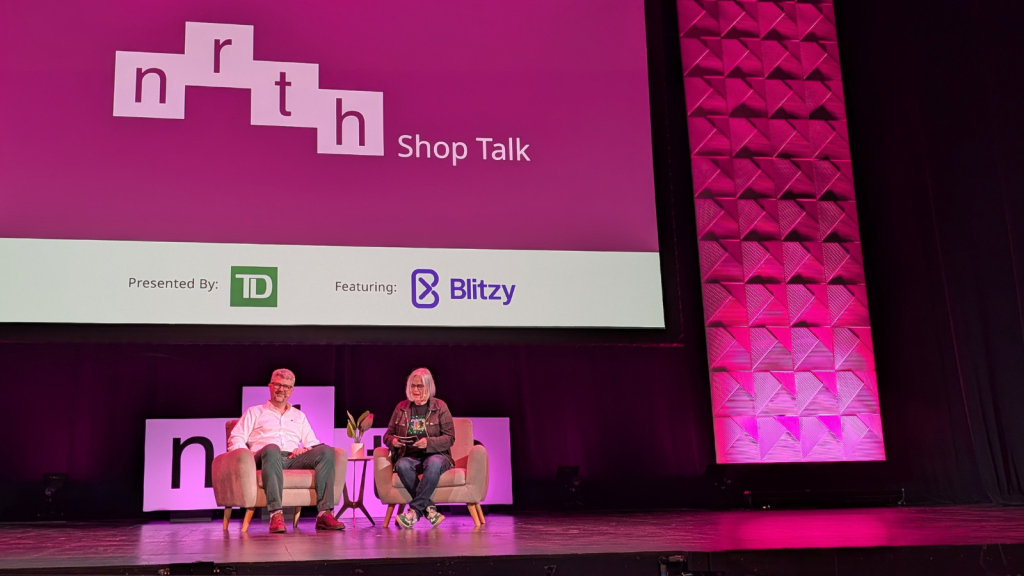
Agentic AI will be part of how TD gets there, she said at Nrth, the innovation event previously known as Elevate, alongside Yarik Chinskiy, the bank’s head of data and AI architecture.
Racine’s T-shirt was bedazzled with a sparkling TD logo. She opened by teasing Chinskiy for showing up in green pants, presumably a nod to TD’s famous green branding.
On stage, they laid out what changes once an AI system stops waiting for questions and starts working toward a goal.
The difference between an assistant and an agent
Generative AI waits for a question and gives an answer, Chinskiy explained. Agentic AI gets a goal, a set of constraints, and a definition of what good looks like, then goes and produces a result.
He compared it to the difference between Google Maps giving directions and a self-driving car taking you there. In both cases, the human retains control.
“We remain in the driver’s seat, we make decisions,” he said. “We understand the consequences, and humans remain accountable.”
Keeping humans in charge, Chinskiy said, shapes what TD needs from the platform running underneath those agents.
TD’s platform for agentic AI is federated by design
Chinskiy said an enterprise of TD’s size needs a federated platform for agentic AI, one that can expand with the agents, data, and tools needed for different kinds of work.
A federated architecture allows different parts of an organization to use different technology while keeping some shared standards, controls, and infrastructure in common.
At TD, Chinskiy said that common layer is governance.
In his framing, agents are new participants in the organization, each with its own identity and controls.
Racine applied the same logic to who builds the agents. Centralizing that work, she said, costs TD speed, scale, and the subject matter expertise held by the people who understand how the business works.
Chinskiy tied governance directly to how quickly TD can put new AI capabilities into use. He pointed to rules built into the technology, ways to test how well it is working, and systems that track what it is doing as the pieces that let the bank assess and control new tools as they are introduced.
“It really should be considered as that grease that greases the wheels, so we can actually move fast,” he said.
Racine described the same idea using the software development concept of “shifting left,” which means moving checks and controls earlier in the process instead of adding them near the end.
“Governance moves left,” she said. “Everything is moving left in the equation, which makes it much easier to get through these projects.”
On a project timeline, “left” is earlier in the build and “right” is closer to launch.
Checks like a security review and compliance approval traditionally ran at the end of development, right before something shipped. “Shift left” means building those checks into the design and development process from the start, instead of gatekeeping at the finish line.
Applied to agents, it means governance rules get written into the pipeline as automated policy, not reviewed by a person after the fact.
Racine said TD wants the people with the domain knowledge building the agents themselves. Putting all of that work in one central team, she said, would cost the bank speed, scale, and the subject matter expertise held by the people who understand how the business works.
The architect’s job is changing
Chinskiy pushed back on the idea that TD’s legacy systems are something to work around.
“We cannot just abandon what we have and do big migrations,” he said. TD’s existing foundation, in his view, is something to build on, delivering incremental value as it goes. A platform never stops evolving, he said, until the day it’s retired.
Chinskiy said architects are moving from designing systems on paper to building rules and governance directly into how those systems operate.
He described that as “executable architecture,” where policy, governance, and rules are built into the delivery pipeline so agents can make decisions and create workflows inside defined limits.
He also said agents need access to the organization’s accumulated knowledge if they are going to operate effectively inside it.
Racine pointed to TD’s cloud data platform, completed in June 2024, as one piece of that foundation. She said it has accelerated AI solutions because trusted data is already accessible.
The next challenge is making sure that growth stays visible and governed.
TD expects ‘agent sprawl’
“Is there going to be agent sprawl? A hundred percent,” Racine said, though her concern was more on unfocused, ungoverned sprawl.
She described a friend at a consulting firm whose client came to them after accumulating 5,000 agents and spending more on AI than expected. The company didn’t know what many of those agents were doing, when they were running, who was using the output, or what outcome they were producing.
Chinskiy then asked why agents that are easy to build so rarely make it to production.
Building an agent that produces a slick demo is easy, explained Racine. Getting it ready for use in a regulated environment and established as the agent responsible for a specific outcome is harder.
“If your agent is more expensive than the value you’ve achieved, then you should be retiring that agent,” she said.
Companies need to manage the entire agent lifecycle, including when an agent stops earning its place. They need to know what each agent does, what it costs, and what outcome it produces.
The plan for limiting vendor lock-in
Chinskiy said TD does not want to flatten every vendor into the same generic technology layer if that means losing the capabilities that made each one useful.
At the same time, he said the bank can put common contracts, integrations, and governance around those systems so it can add or replace new technology later.
Some lock-in can be acceptable, he said, if it gets TD somewhere faster and the bank can put boundaries around it.
The key is keeping employees away from the underlying “plumbing.” If the experience they use stays consistent, TD has more room to change the technology underneath it.
TD’s approach depends on building enough governance into the system that new agents, vendors, and tools can change without forcing the bank to rebuild around them.
Final shots
- Governance has to be built in from the start if companies want more people building AI agents without creating a bottleneck before launch.
- Agent sprawl becomes a problem when nobody knows what an agent does, what it costs, or whether anyone still needs it.
- Managing vendors gets easier when companies can change the technology underneath without changing how employees use it.
TD’s AI push runs on governance
#TDs #push #runs #governance