Post-hype AI: Verification becomes the differentiator

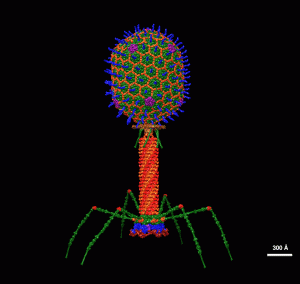
Photo courtesy of Liner AI Figure Generator.
Opinions expressed by Digital Journal contributors are their own.
AI has reached the stage where the novelty is no longer the story. Most people who work with information have tried a chatbot. Many have also run into the same friction point: the answer sounds confident, but it is hard to tell what it is based on.
That trust gap is increasingly shaping how AI is used in real workflows. In academic settings, it shows up as questions around citations, integrity, and whether students can demonstrate where information came from. In professional settings, it shows up in a more pragmatic way: teams want speed, but they also need to defend decisions with sources.
Tools are beginning to respond to that shift by treating verification as a core product feature rather than a best practice users are expected to remember. One example is Liner, an AI research agent for people who need answers they can verify. The company’s premise is simple: if an answer matters, users should be able to see the source behind it and check context quickly.
Liner combines source-backed AI search, purpose-built academic research, and writing workflows in one platform. Unlike general AI tools, Liner is built around reliability, citation transparency, and serious research use. The company says it is seeing meaningful adoption in the U.S. through .edu usage at top universities, alongside broader global use across more than 220 countries. With global traction, growing U.S. campus adoption, and benchmarked accuracy, it is emerging as a credible alternative to U.S. AI giants. The way it is positioning the product mirrors a broader pattern across AI: an emphasis on provenance, attribution, and workflows that make source checking easier.
That focus on verification also connects to a wider debate about AI’s effect on work. Some coverage has challenged the most dramatic jobpocalypse predictions and suggested the immediate impact is more incremental, with many roles evolving as tasks change. From that perspective, AI’s real influence shows up less as wholesale replacement and more as a set of workflow shifts in how people research, summarize, and synthesize information.
In those workflows, the difference between helpful and reliable matters. Generative systems can compress time, but they can also introduce errors that get repeated and amplified. For users working on anything consequential, the question becomes whether AI can make the verification step faster, not whether it can remove it entirely.
That is the bet behind citation-first products. Instead of treating sources as an appendix, the interface is built to keep evidence close to the answer, making it easier for a user to click through, compare, and decide what to trust. In practice, this can be the difference between using AI as a starting point and using it as part of a defensible research process.
That same logic is now extending beyond retrieval and citation into how research is communicated. Liner recently launched Figure Generator on Liner Scholar, a feature that lets users highlight a dense section of an academic paper and generate a visual to clarify it. The tool can also suggest where a figure might be most useful within a paper, bringing Liner’s evidence-first approach into visual explanation as well.
This matters because figures remain one of the most manual parts of the research workflow. In fields such as AI, biology, and computer science, visuals are often central to whether a paper is understandable, credible, and citable. Researchers may use AI to retrieve information, summarize material, or help draft text, but they still often leave the platform entirely when it is time to explain an idea visually. Features like Figure Generator point to a next phase of AI assistance: not just generating more text, but helping make complex information legible.
Rather than asking users to move from a research interface into PowerPoint or Illustrator to create a first-pass visual, the feature is designed to keep explanation closer to the underlying source material. The underlying idea is the same one shaping citation-first AI more broadly: if these tools are going to help people work faster, they also need to help them stay grounded in the original context.
The takeaway is not that citations solve every problem. Sources can be misinterpreted, cherry picked, or taken out of context. But as AI becomes embedded in everyday knowledge work, the expectation that tools show their work is likely to rise. Verification is becoming less of a niche preference and more of a baseline requirement.
Post-hype AI: Verification becomes the differentiator
#Posthype #Verification #differentiator