From life skills to literacy: How Maria Jessica Roa builds belonging in early special education
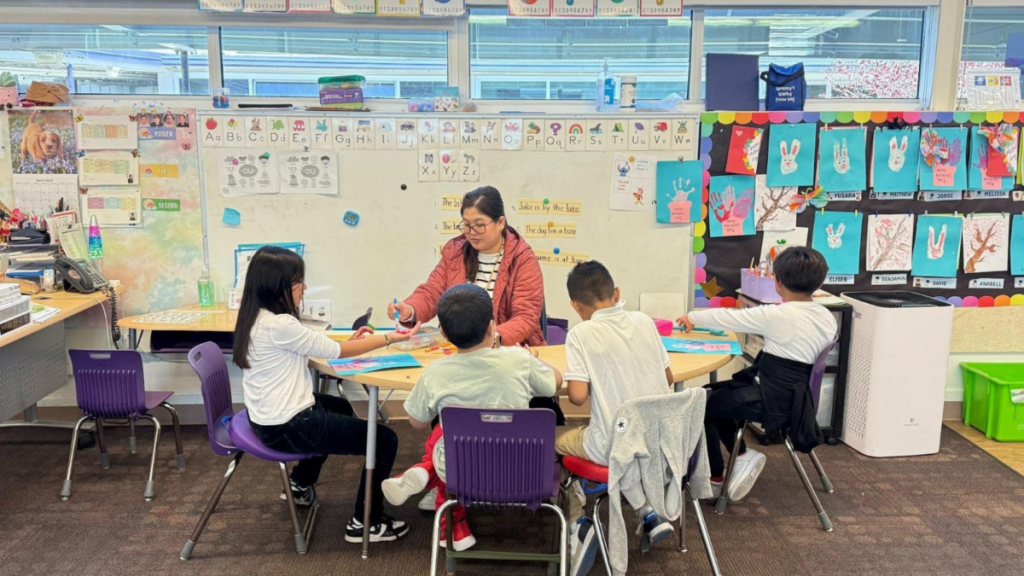
Photo courtesy of Maria Jessica Roa.
Opinions expressed by Digital Journal contributors are their own.
On the first day of school, some of Maria Jessica Roa’s students do not yet know how to sit in a circle. A few may wander out of the room without warning. Others arrive without the language to name their emotions or the tools to ask for help. And yet, by June, those same children are sounding out words, solving basic math problems, and — perhaps most remarkably — learning what it means to belong somewhere.
Roa is a Special Education teacher serving kindergarten through second grade at Martin Elementary in South San Francisco, California. She came to the United States carrying more than a decade of teaching experience from the Philippine public school system and a philosophy shaped by scarcity, resilience, and love for the work. What she has built in her classroom is not a program. It is a practice — daily, deliberate, and deeply human.
A legacy borrowed and earned
Teaching runs in Roa’s family, though not in the way one might expect. Her mother was studying to become a teacher while pregnant with her, but financial hardship ended that dream before it could be realized. Roa grew up playing school with her dolls, lining them up and teaching them imaginary lessons. When she entered the profession formally in 2011, joining Commonwealth Elementary School in Quezon City under the Philippines’ Department of Education, it felt like a continuation of that dream.
She spent a decade there. She taught students with special needs, focusing on life skills development and community inclusion. She served five years as a department chair, leading school programs that brought out her students’ strengths. One of her most vivid roles was coaching Bocce — a sport included in the Quezon City Paralympics. Her athletes trained steadily, grew in confidence, and many went on to compete at regional and national levels. That coaching work earned her a seat at a Department of Education write shop, where she contributed to a national Bocce manual now circulated in public schools across the Philippines.
The years were rich, but not easy. Resources were stretched thin. Families struggled to get their children to school due to poverty and long distances. One time, one of her students arrived wearing two left shoes. When she noticed, she bought him a new pair. Despite the difficulties, her students were eager to study.
“They were hungry to learn,” she recalls. “That hunger shaped me and motivated me to keep going.”
Crossing into a new system
The COVID-19 pandemic changed Roa’s trajectory in ways she had not anticipated. As the world reconfigured itself, she made a decision that was equal parts professional ambition and personal reckoning: she would join a teacher exchange program and move to the United States.
The transition was bracing. The American special education system operates on an architecture of compliance — Individualized Education Programs, multidisciplinary team meetings, paraprofessional coordination, and layered documentation requirements that bear little resemblance to the independent classroom model she had known in the Philippines. She had to rebuild her professional understanding almost from the ground up, while simultaneously navigating cultural distance, language nuance, and the quiet pressure of proving herself in an unfamiliar setting.
There were moments of genuine doubt. She questioned whether her background would translate, whether she would be accepted, and whether the gap was too wide to cross.
“What I had was the heart of a teacher willing to learn and serve the best that I can,” she said.
That turned out to be enough. Today, between 95 and 99 percent of her students are meeting their IEP goals — a metric that places her among the most effective practitioners in her field. IEP meetings run on time. The plans are well-written. For families who have spent years navigating a system that can feel indifferent, that reliability is valuable.
Building belonging, one routine at a time
Roa’s classroom runs on structure, but it is structure in service of warmth, not control. Before phonics or numeracy, she teaches children how to transition between activities, sit, and ask for help. She uses daily emotional check-ins with visual supports, such as color charts, calm corners, and breathing techniques, to give students the vocabulary for what they feel before they are asked to perform academically.
She calls this approach “Little Learners, Big Voices,” a philosophy calibrated to SSFUSD’s Portrait of a Graduate framework and adapted for students with diverse learning needs. Small moments of achievement are named and celebrated — a student who stayed in their seat, a child who tried a task before asking for assistance. “A small win is a win,” she tells her team.
Her current research deepens this work. Her forthcoming publication, T-P-C Framework: A Collaborative Practice Between Paraprofessionals and General Education Teachers in Inclusive Education, examines how inclusion lives or dies on adult alignment. She has watched, up close, how much the relationship between a classroom teacher and a paraprofessional determines whether a child with special needs genuinely belongs in a room, or simply occupies a seat in it.
“Inclusion will not be successful if there isn’t a general education teacher willing to open the classroom door and welcome a student with special needs,” she has said.
That observation, drawn from years of direct practice, carries the weight of a practitioner who has seen both sides. The T-P-C Framework offers a replicable structure for getting adult collaboration right. It is a contribution aimed squarely at the professional communities of NASET and the American Federation of Teachers, where such tools are urgently needed.
But behind the research and the frameworks, Roa’s motivation has always been simpler than any model can capture. She measures her success in ways that no benchmark captures cleanly: the child who stays in the classroom instead of walking out; the student who sounds out a new word alone for the first time; the parent who messages to say their child now loves school. From Quezon City to South San Francisco, across fourteen years and two continents, she has pursued the same simple, radical idea — that every child deserves a real place in the room.
“I want to be remembered as the teacher who is loving and selfless,” Roa concluded.
From life skills to literacy: How Maria Jessica Roa builds belonging in early special education
#life #skills #literacy #Maria #Jessica #Roa #builds #belonging #early #special #education