Humans might be cheaper than the robots after all
Cecilia Carbonelli told her executive team that hiring humans might be cheaper using AI.
She knows people get sick and go on vacation. The problem is that she can’t get a vendor to give her a reliable estimate of what the AI will cost.
“Some of these hyperscalers still to this day can’t answer us on projected costs,” says Carbonelli, CIO of Haventree Bank.
For the three private sector CanadianCIO of the Year Awards finalists, the question is how to measure the value of AI.
John Comacchio runs technology at Teknion, a Toronto furniture maker that sells around the world, and he can see what the AI tokens cost without being able to say what they’ve returned. Brigitte Larivière told Bombardier’s board that Copilot helps people work faster and that they shouldn’t go looking for a dollar figure on that one.
Scroll down for the full conversation
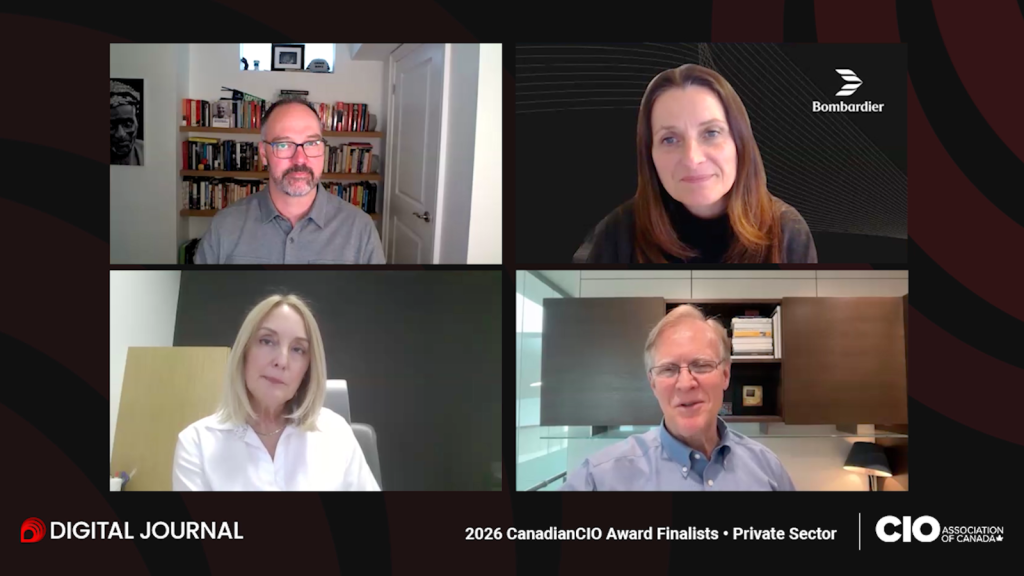
David Potter, senior contributing editor at Digital Journal, sat down with this year’s finalists to talk about AI ROI, talent, compliance, build versus buy, and the blind spots that can come with adopting the technology.
Read the finalist profiles:
All three have staff using AI today. What it gives back is a number they’re all still waiting on.
For example, Carbonelli wants an agent tasked with reading Haventree’s property valuation reports.
Typically, someone at the bank reads 30 pages of one before a mortgage gets approved, and she wants that done in seconds. What the bank is building first is the infrastructure underneath it, controls on the data an agent can reach and a way to watch what it does.
Comacchio runs technology at Teknion and he started with the AI already inside the software the company runs. He switched it on wherever he could, put training and guardrails around it, and let people use it without asking what it could do.
Then he watched the token bill.
“I think it’s one of those necessary evils where we have to spend the money to learn, and we have to hit the wall to understand,” says Comacchio.
Larivière is vice-president and chief information officer at Bombardier, where about 2,000 people have a Copilot licence. She told the board that one sits apart from the AI work carrying ROI figures, because what it buys is people getting through their work faster.
Her plan for 2027 is showing departments their usage and cost, followed by charging for these in 2028, or sooner if costs climb. It’s the model she uses for phones, where a department gets told what it used and pays for the handset and minutes.
She expects some people to run up a far bigger tally than others, and she’s fine with that, where those people are producing the work for a whole team.
“I want them to first see the bill, and after that pay for it. So if you see value, you’ll be okay to pay,” says Larivière.
Charging now would end the experimentation before anyone has learned what the tools are good for, which is why she’ll issue reports in 2027, not invoices.
Some of the work may never need an agent at all.
Larivière gave her team a mandate for 2026, to automate what you can in infrastructure services, the patching and the server reboots, and don’t come back with an ROI figure. They’ve since automated more than 800 scripts.
In 2027 she puts AI on top of those scripts, with a set order to run them in and no room to improvise.
“Automate everything you can, and then move it to AI,” says Larivière.
Carbonelli makes the same case about tool choice, one she says comes up with her Toronto CIO peers. Plenty of the work can be handled by a script someone wrote, and that costs less to run and less to watch.
“Not everything needs an agentic AI agent,” says Carbonelli.
Three years ago Haventree’s technology group was mostly infrastructure and everything customer-facing went to outside firms. She now has 23 engineers on staff. The newest of them come out of school having used AI for years already.
“What they come in a little green on is the guardrails around the use of AI,” says Carbonelli.
Comacchio sees the same thing at Teknion.
“What they don’t really know is data governance and workflow mapping, right? Which is really 80% of AI as far as a project,” says Comacchio.
Everything the three of them described as the real work is coming in 2027. Until then, they’re doing the work nobody gets an award for, but everybody notices when it’s missing.
Watch the conversation:
This article is part of a series profiling the finalists for the 2026 CanadianCIO of the Year Awards, private sector category, presented by the CIO Association of Canada. The winner will be announced Oct. 1 in Toronto. Digital Journal is the national media partner for the CIO Association of Canada.
Humans might be cheaper than the robots after all
#Humans #cheaper #robots