What a smarter factory robot still can’t fix
A robot arm that runs the same weld a few thousand times a day is a solved problem.
Ask it to find a part that never lands in quite the same place, pick it up without crushing it, and fit it into a housing that varies by a millimetre. That’s the kind of work that has kept much of the factory floor in human hands.
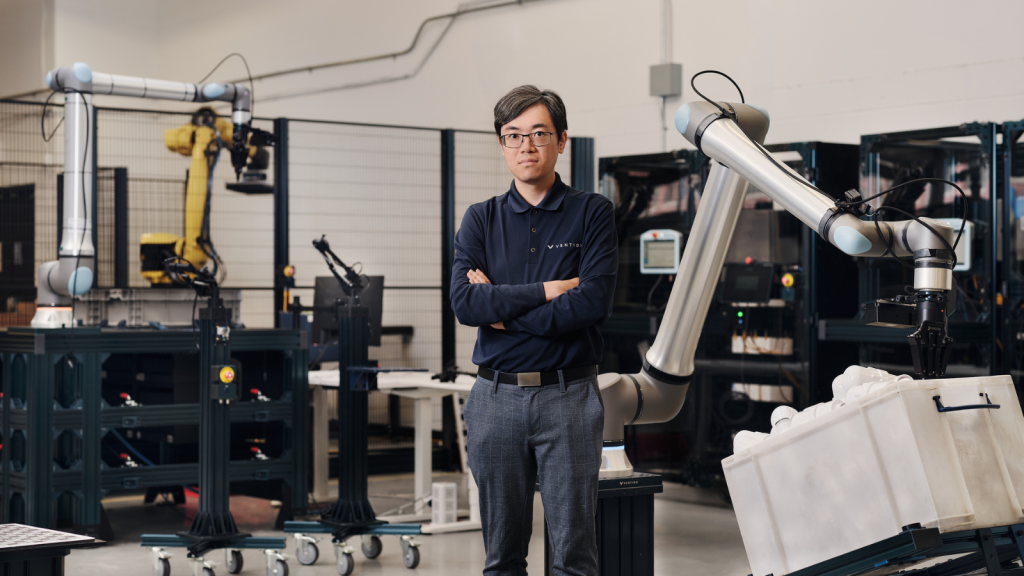
Vention, the Montreal industrial automation company, opened a physical AI lab this week built around that robotic manipulation problem.
Jimmy Li, Vention’s director of physical AI, leads the lab, with Cohere’s Joelle Pineau advising.
“Our clients aren’t waiting for a finished product to test,” says Li. “They’re in the room while we build it. That’s unique in this field, and it’s what lets us move faster from a research result to something that actually runs on a factory floor.”
It wasn’t the only physical AI flag planted in Canada in the past week.
Six days earlier, PwC Canada launched a consulting practice built to move robots and autonomous systems out of the lab and into mines, plants, and logistics floors. Vention says physical AI is its fastest-growing business, with related revenue up 400% in the past year, a figure it hasn’t broken down.
“The challenge is no longer simply proving that a robot can perform a task in a lab,” says Etienne Lacroix, Vention’s founder and CEO.
On the factory floor, even some of the technology physical AI relies on is still uncommon. Among businesses already using AI, just 4.6% use machine or computer vision, and StatCan doesn’t track factory robots as their own category yet.
Adopting AI is one thing. Getting your money back is another.
StatCan looked at whether AI adoption actually lifts productivity. Companies using AI were more productive, but most of that edge came from things those companies already had, like R&D, cloud computing, data analytics, advanced robotics, and ICT training.
Account for those, and the productivity advantage tied to AI itself shrank to 5.1%, small enough that the researchers couldn’t call it statistically significant. The data ran from 2019 and 2021, so it can’t speak directly to the physical AI arriving now. It does show how much the payoff from AI can depend on what surrounds it.
The skills to run a physical AI system are already scarce.
StatCan says 12% of manufacturers name a lack of skilled workers as a barrier to using AI at all. A physical AI system leans on those same people to connect it to the line, maintain the data it relies on, and get it running again when it stops.
That’s the question nine Prairie aerospace and defence manufacturers are working through right now, splitting the cost of AI pilots to see which ones are worth paying for again.
“The real opportunity is making these capabilities reliable, economical, and deployable across thousands of factories,” says Lacroix.
The robots are ready for the factories. Most of the factories aren’t ready for the robot.
Final shots
- Vention and PwC both put deployment at the centre of their recent physical AI announcements. Buyers still need to price the data, integration, training, and maintenance around the robots.
- The 5.1% StatCan result does not prove AI has no payoff. It shows that companies’ existing capabilities account for much of the measured productivity advantage.
- A physical AI pilot should have to answer two questions before it expands. Can it run reliably on the line, and would the plant pay for the next one itself?
What a smarter factory robot still can’t fix
#smarter #factory #robot #fix