Manufacturing: How trainees combine tech and age-old skills
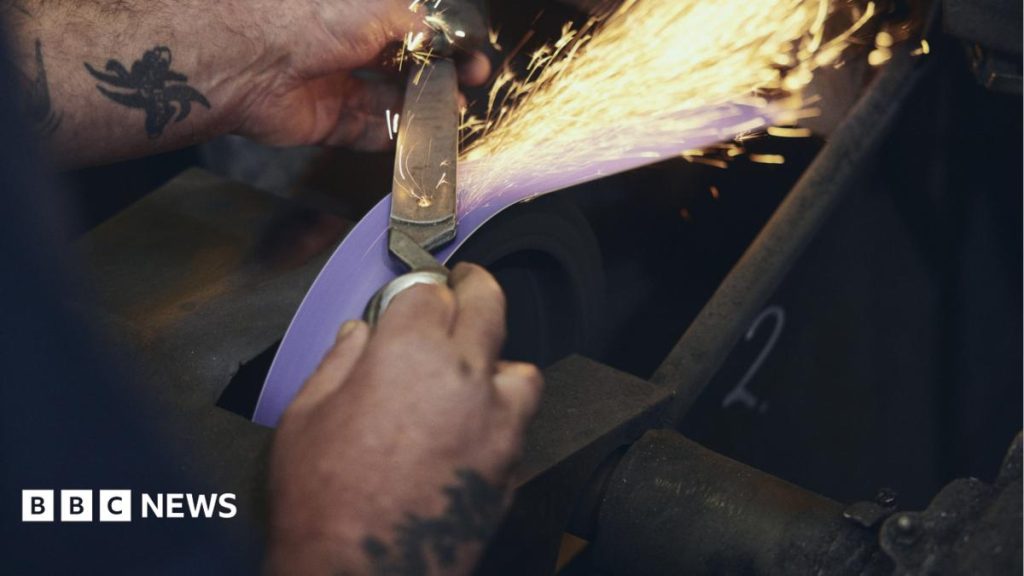
Ollie Priestley is not just doing any mechanical apprenticeship.
Working at specialist car restoration business Tolman, Priestley, 29, has embarked on a “heritage vehicle technician” apprenticeship. He’s learning the skills to work on modern classic cars that need a mix of traditional and new techniques to restore.
New technologies are enabling those techniques – from computer-aided design (CAD) for new vehicle components, to 3D printing them, as well as learning the intricacies of a car’s electronic control units.
“I wanted to develop the skills that allowed me to work on the cars that I love and excite me, like the Peugeot 205 GTi,” says Leicestershire-based Priestley.
“Getting to know how to make things keeps me focused and engaged. I’ve just fabricated a gearbox mount for a classic BMW. It’s cool to know that the things I create will bring the car back to life.”
Tolman founder Chris Tolman says what Priestley is learning sets him apart from apprentices in mainstream car dealerships, who, due to digital tools, are increasingly becoming “just fitters”.
“The computer identifies the issue and they swap the part. For specialist car businesses, our technicians need to identify and understand a problem, and then be creative and innovative to find the answer,” says Tolman, who is based in Warwickshire.
Tolman’s point highlights an important question hanging over how trade apprentices are being taught today, as technology plays an increasingly bigger role.
As a result, apprenticeships are moving up the education value chain.
For example, Priestley’s three-year apprenticeship, which he is doing through the Heritage Skills Academy in Bicester (HSA), was introduced in 2018 to incorporate 3D printing and CAD amongst other digital skills, alongside essential skills like welding and glazing.
It is a level three apprenticeship offering the equivalent of three A-levels. It replaces the previous level two and three “classic vehicle framework” apprenticeship.
HSA managing director John Pitchforth says it’s “radically improved” as it combines “modern technology with engineering fundamentals”.
Government apprenticeship data also shows that the number of people starting level two intermediate apprenticeships have fallen by nearly a quarter over the past year, in favour of people starting higher level apprenticeships – level four to seven.
Level six and seven respectively equate to bachelors and masters degrees. Level three apprenticeship numbers have remained stable.
But with tech having a growing influence over the curriculum, are apprentices now just learning how to run computer software, at the expense of the actual skills of a specific trade?
HSA’s Pitchforth argues that the organisation’s apprentices come out highly skilled – perhaps more so than those from other programmes.
“When modern engineers come to us to transfer into our sector, they often lack the basic engineering principles and are unable to diagnose and repair vehicle systems without a computer telling them what’s wrong,” he says.
Source link