The era of the generalist board director is over
“You guys are trying to play in a baseball game. The game hasn’t even started for you yet. Other companies are in the sixth inning, and you’re sitting on the benches waiting for the game to start,” said Carol Leaman.
As an advisor sitting on several boards, she’s seeing the same conversation on repeat. Boards of directors are asking how to bring AI into the business, years after they should’ve been asking about their data, models, and infrastructure.
In a panel discussion at the Council of Canadian Innovators (CCI) Innovation Governance Summit 2026, Leaman used the baseball analogy to describe a strategy meeting from a few weeks ago. A large, established company in a traditional industry was still treating AI like next year’s problem.
They wanted to play the game, but they’re stuck in the dugout. A CIO can bring a serious AI architecture issue, data governance issue, or vendor risk to the board, and lose the room if the directors don’t understand the decision in front of them.
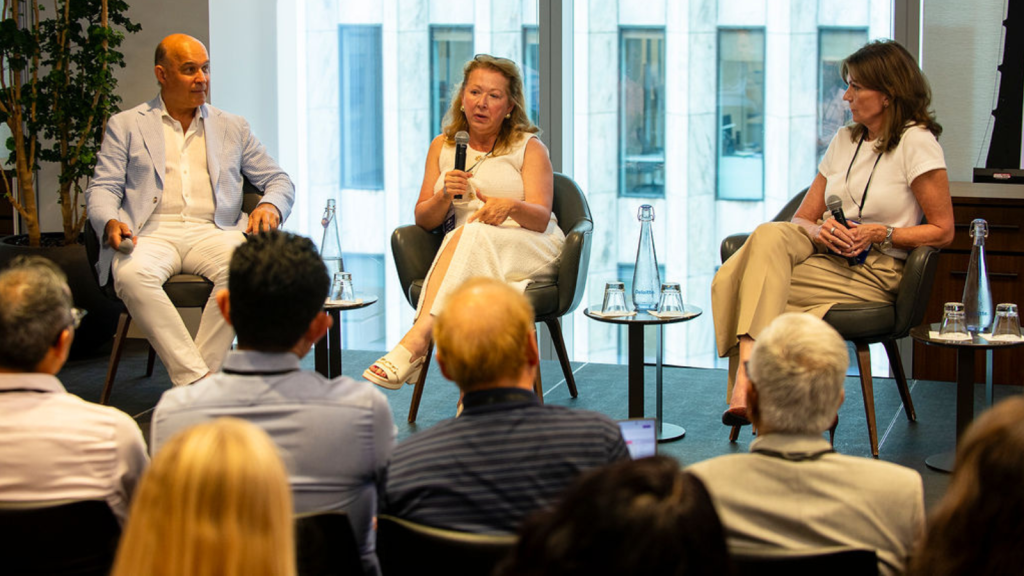
Joined by Jim Balsillie, CCI chair and Carol Wilding, president and CEO of CPA Ontario, the panel made the case that most directors don’t understand the technology and data decisions they’re supposed to be governing, at exactly the moment Canada can least afford it.
“The global economy has undergone an unprecedented 40-year transformation, where wealth, power, and security are rooted in the ownership and control of intangible assets: IP and data AI,” explained Balsillie.

As Balsillie warned the room, the era of relying on ‘general business judgment’ is over.
It’s a hard point to argue with, since, as he said, intangible assets make up 90% of all business value.
These assets that now decide who competes and who gets left behind, with IP and the AI built on top of it, are what most Canadian boards are least equipped to govern.
Directors were trained to read a balance sheet and make sure the right mix of professions and sectors had a seat at the board table. Now they’re being asked to govern data sovereignty, the AI models the business runs on, and tokenization.
Many simply can’t, leaving Canadian companies acutely exposed.
The U.S. is rapidly weaponizing AI, IP, and data as core instruments of national power, while, according to Balsillie, Canada’s economic thinking remains structurally rooted in the 1970s.
Technology leaders answering to these boards can bring a critical, survival-level AI strategy to the table and still lose the room simply because the directors don’t understand the game being played.
Today’s boards need to have some degree of technical knowledge, according to the panellists. It’s a governance blind spot that needs to be at the top of a company’s to-do list.
The economy has moved, but governance hasn’t caught up
“There is an undercurrent going on here globally that, as board members, you must pay attention to, and then bring that knowledge and experience to the boards that you’re on, and play the game,” said Leaman. “It is a very intense game that has started, and all of our companies need to be playing it.”
When the United States withdrew from 66 multilateral institutions in January, it kept its seat at three: the International Telecommunication Union (ITU), the International Organization for Standardization (ISO) and the International Electrotechnical Commission (IEC).
These bodies write the rules that decide how technology from different makers works together. According to Balsillie, whoever shapes those rules can build their own patents into them, so everyone else ends up licensing that technology to stay compatible. For a Canadian company, that means the cost of interoperating, and the terms, get set by someone else.
He sees the same play in USMCA, another lever the US is using to hold its lead.
“The digital architecture is a highly technical layer of the economy that Canada mismanaged in USMCA, which was more capitulation than negotiation, disproportionately benefiting Silicon Valley,” said Balsillie.
Leaman told directors to treat a recent speech as mandatory reading. U.S. Treasury Secretary Scott Bessent set out five strategic “thrusts” or pillars the American government is focused on: domestic manufacturing, reciprocity in trade, writing the global rules on AI and trade, dollar dominance, and broader share of prosperity among Americans.
“It’s having a massive impact on the rest of the world, including Canada,” said Leaman.

Balsillie gave directors two places to start.
The first was an MIT report that found organizations “deeply committed” to controlling their data, infrastructure, models, and governance are delivering five times the ROI on generative and agentic AI initiatives.
The second is a recent guide from Palantir CEO Alex Karp, called Institutional Sovereignty in the Age of AI, where Karp outlines “15 steps that every government and company can take to compound their alpha in the age of AI.”
As Balsillie explained, “he basically says you’re paying tokens for these foundation models to suck the alpha out of your business and give it to new competitors.”
In the guide’s introduction, Karp wrote “In the age of AI, institutions are being led to believe their choices are narrower than they are — leaving critical decisions about how this technology is being deployed and applied to their data in the hands of others. In reality, you have complete agency over your AI model usage.”
“You can’t lock yourself into one particular system,” said Wilding
A board seat has to be earned with real expertise now
Balsillie’s test for a director starts with whether they understand the technology at all.
“It’s like general business judgment for a neurosurgeon,” he said. “You have to know what you’re doing. Great diagnostic tools, but tremendous artisanal and technical knowledge.”
Wilding made a similar point.
“The whole piece around just AI in and of itself, let alone the integration of data, really is IP,” she said. “Whether you’re in a tech company or even if you’re in a legacy company.”
She sits on the board of a private insurance brokerage and a hospital, two places with not only huge quantities of data, but sensitive data. Both, according to Wilding, “are being completely reshaped in terms of their strategies and how they move forward.”
That kind of basic business knowledge isn’t enough anymore.
“If you’re going to be at a director level, you have to have an in-depth understanding,” said Wilding. “How AI is disrupting the business model…how do we use AI-assisted coding, or do we have AI agent applications, and how do we decide which ones?”
Directors need to be having these conversations, “but you can’t have them if you don’t understand how it works.”
For Wilding, this is where the risk gets real for directors, whose job comes with a fiduciary duty.
She used the example of tokenization, or putting real assets on a blockchain or digital platform as digital tokens. It’s a concept she said is moving fast, while most boards are still trying to define it.
“Everything is getting tokenized, but if you don’t understand it, you can’t actively exercise your fiduciary duty or oversight,” said Wilding.
Leaman watches boards still fill their seats by profession, adding a doctor, a lawyer, an accountant as they see fit. It’s a traditional mindset.
Echoing Balsillie, she said in reality you need very smart people who are not afraid to roll up their sleeves and dig in, not just act as an arbitrary representative.
“It’s who is going to add value to my business, and be willing to spend the time to add that value, and not just check the box,” said Leaman.
Having recently filled in an annual skills inventory for one of her board positions, she believes that boards need to seriously consider the composition of what the table now looks like, and “actively manage out” those not adding value.
The question Wilding now hears in those rooms has changed.

“How do you create tangible value in an intangible world?” she asked.
Wilding chairs the foundation of Sunnybrook Health Sciences Centre in Toronto, where there is a significant digital transformation underway. She explained a recent joint session between the boards of the foundation and hospital to talk about their AI value map.
Like with most organizations, it all comes down to data. For a hospital, and the vast amounts of data it has, putting this data into an AI-ready mode isn’t an all-at-once job.
“It’s got to be an iterative process, and you have to have the right guardrails from a risk perspective,” said Wilding.
“These things take a lot of time because there’s a lot of data, a huge amount of risk, and it requires a project plan,” she said. “It needs a very well-educated champion.”
What happens if the model you’re built on disappears
Wrapping up the discussion, an audience member asked a question that many boards might’ve not yet considered. Or, more dangerously, have ignored or pushed to the side.
As a serial entrepreneur now building an AI company, he told the room that China had spent the week debating whether to wall off its open-source models for domestic use only. If you run a business on tools a foreign government can switch off, he said, the exposure stays invisible until the day it isn’t.
“What happens if we turn the power switch on,” he asked, “and there isn’t power anymore because it’s not available to us, because of the government?”
Wilding said many directors are still talking themselves out of the risk entirely.
“There are some pretty traditional legacy boards out there that are rationalizing away why this access issue is really actually not a problem,” said Wilding.
The story those boards tell themselves is that someone bigger has it handled, that a large enough bank or insurer is shielded from where its data goes. She has no patience for it.
“Maybe it’s a denial that it truly will impact my company,” she speculated, “‘I’ve got enough big protection or big brother around me.’ No, no, we don’t.”
Leaman, who admitted the whole thing can feel intimidating for anyone who isn’t a tech person by nature, told the audience the starting point is not the obstacle they think it is. “The reality is, most of us are not tech people, and we’re in the same boat. We all have the capacity to learn and find those videos, those documents, those interviews, those formative things,” she said. “Don’t be intimidated by your own starting point.”
To use a common refrain from social media comment sections, Google is free.
A board that doesn’t understand the exposure is a board that won’t fund the fix. Every technology leader trying to get data control or security spending signed off already knows how that meeting will probably go.
Final shots
- General business judgment can’t govern data, model dependence, and tokenization anymore. The boards still filling seats by profession, checking off specific boxes, carry the most risk without seeing it.
- The divide now is between boards that hand off the AI question and boards that go learn it.
- The boards most exposed are the ones sure they’re covered. No bank or insurer is big enough to have this handled for them, and the directors who see that are the ones who should be leading the fix.
The era of the generalist board director is over
#era #generalist #board #director