Alberta facility produces first certified carbon removal credits in North America
Carbon credits have long had a verification problem.
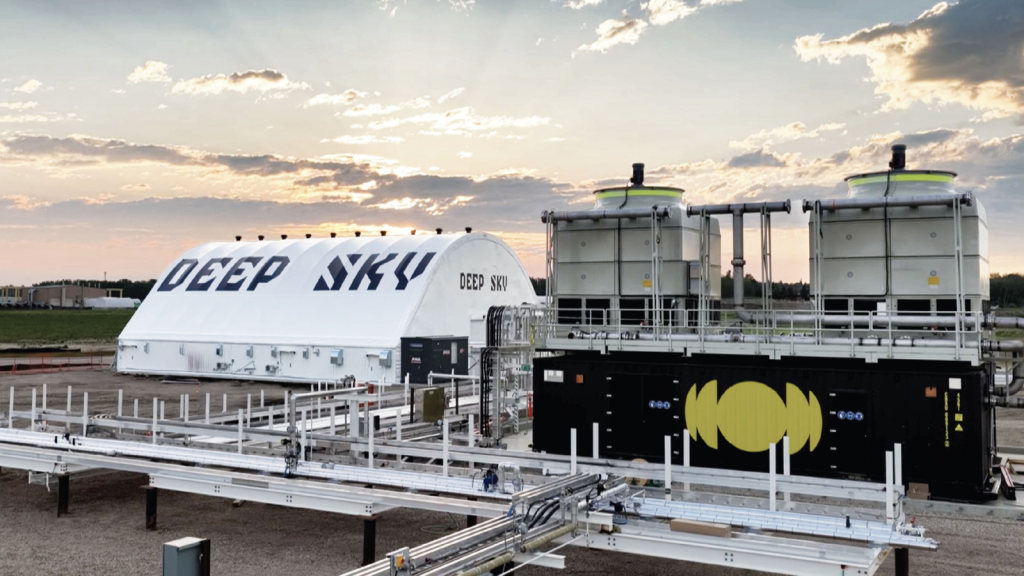
On Monday, Montreal-based Deep Sky and London-based certifier Isometric announced that carbon captured by Deep Sky Alpha in Innisfail, Alta., has been independently verified and registered as North America’s first certified direct air capture (DAC) carbon removal credits.
Direct air capture is trying to give buyers a cleaner receipt.
Machines pull carbon dioxide from the air, project emissions are counted, and the captured CO2 is injected underground for long-term storage. It’s still expensive and small by industrial standards, but the claim is easier to test than many credits built on avoided emissions or protected land.
The buyers are Microsoft and Royal Bank of Canada (RBC), under a supply agreement running through 2034.
“From day one, we’ve believed that leadership in direct air capture would be earned through execution,” says Alex Petre, CEO of Deep Sky.
The certification matters as much as the capture. Isometric’s Direct Air Capture Protocol requires full lifecycle emissions accounting and long-term monitoring to confirm the carbon stays underground.
Isometric is also the first certifier approved by the Integrity Council for the Voluntary Carbon Market to issue credits carrying the Core Carbon Principles label, a quality benchmark buyers can use to distinguish higher-integrity credits from weaker claims.
These are the first CCP-labelled direct air capture credits anywhere in the world.
They are not the first certified DAC credits globally. Climeworks has delivered certified DAC carbon removal from its Orca plant in Iceland under the Puro Standard.
Deep Sky’s milestone is narrower and still significant. It is the first certified DAC credit issuance in North America, and the first DAC credit issuance carrying the Core Carbon Principles label.
The larger Stratos facility in Texas, built by Occidental subsidiary 1PointFive, shows where the market is trying to go next. It’s designed for much larger volumes and has signed major purchase agreements with Microsoft and Amazon.
Deep Sky’s Alberta project has now moved from contract to certified delivery.
Deep Sky has previously said the Microsoft and RBC agreement calls for an initial 10,000 tonnes of removals, with options to purchase an additional 1 million tonnes from future commercial projects.
The company has not disclosed pricing for the certified credits announced this week. Direct air capture remains expensive and small by industrial standards, so this is proof of delivery before it is proof of scale.
The timing connects to something concrete for Canadian organizations.
For buyers, the milestone is less about climate branding than proof. If a company is going to buy carbon removal and use it in a public claim, the credit now needs a record an auditor, regulator, or legal team can follow.
Bill C-59’s anti-greenwashing amendments to the Competition Act, in force since June 2024, put the burden of proof on any company making a public environmental claim. Penalties reach $10 million for a first offence.
OSFI’s Guideline B-15 requires federally regulated financial institutions to disclose Scope 3 emissions by fiscal year 2028. The Canadian Sustainability Standards Board issued its first climate disclosure standards in December 2024. They are voluntary unless adopted into law or regulation.
The RBC piece is where this gets more interesting for Canadian companies.
The bank retired its 2030 interim financed-emissions targets earlier this year, left the Net-Zero Banking Alliance, and pulled its sustainable-finance target, citing policy uncertainty. RBC has cited different reasons across those moves, including methodology issues, changes to Canada’s Competition Act, public policy, energy demand, geopolitics, and the pace of technology deployment.
Buying certified carbon removal credits gives RBC a narrower climate claim with a clearer verification record.
“This is exactly the kind of action our climate strategy is designed to advance,” says Brian Hong, director of RBC’s environmental markets solutions group.
For Canadian organizations building net-zero commitments that have to survive regulatory and legal scrutiny, this is what credible procurement is starting to look like. Verified, permanent, Canadian-made carbon removal now exists.
The volumes are small and the price is high, but the value (at least for now) is the paper trail.
Final shots
- Deep Sky Alpha in Innisfail, Alta., has produced North America’s first certified, CCP-labelled direct air capture carbon removal credits. Microsoft and RBC are the founding buyers under a deal running through 2034.
- The credits land as Canada’s disclosure and anti-greenwashing rules tighten. Bill C-59 raises the burden of proof for environmental claims, and OSFI’s Scope 3 disclosure expectations for federally regulated financial institutions move to fiscal 2028.
- The volumes are small and the price is high. This is not a supply solution yet. It is a sign of where carbon-removal procurement is heading, toward contracts backed by certification, monitoring, and records a legal team can actually use.
Alberta facility produces first certified carbon removal credits in North America
#Alberta #facility #produces #certified #carbon #removal #credits #North #America