The multi-calendar professional is the new normal
Opinions expressed by Digital Journal contributors are their own.
How fractional executives are managing time across multiple organizations
A half-century ago it was more common for executives to spend their entire careers at one company and, for many, to retire with a nice pension. That world seems like a fable today. In 2024, only about 3% of U.S. workers had spent more than 25 years with one employer, according to the U.S. Bureau of Labor Statistics. The median private-sector tenure? Less than four years.
Beyond jumping from company to company in full-time positions, executives are increasingly dividing their time among workplaces and roles. In 2022 the Wall Street Journal spotlighted the rise of part-time CMOs, and in 2025 the Times of London reported that LinkedIn profiles which mentioned “fractional” leadership had surged from about 2,000 in 2022 to well over 110,000 just two years later.
Why multi-company work is increasing
In the last decade, and especially since the COVID pandemic, several drivers have accelerated multi-company work and fueled the prevalence of the fractional executive.
Remote collaboration tools like Slack and Zoom make it possible to lead organizations from anywhere. Startups and small firms seek senior expertise without paying full-time executive salaries, while venture-backed entities increasingly hire part-time CFOs, CMOs and operators across multiple businesses. At the same time, many executives themselves want a greater degree of flexibility and diversified careers beyond single companies.
A downside of this trend: The frustration of coordinating schedules, meetings and overlapping digital calendars across multiple organizations.
What is a fractional executive?
As an umbrella term, “fractional executive” could broadly stand for a range of professionals who work for more than one organization and need to coordinate multiple calendars. These include:
- C-suite leaders managing both parent and subsidiary companies
- Consultants, like IT specialists, servicing a breadth of clients
- Board advisors offering their expertise across organizations
- VC operating partners supporting their portfolio companies
- Sales teams working with multiple companies or departments
- Healthcare staff like medical administrators servicing networked facilities
In so-called “blended workforce” companies, from SaaS startups to media and marketing agencies, mixed labor structures have become the norm, for example blending full-time core staff, project-based workers, independent contractors, AI tools and fractional leaders. Longtime services have sprung up to meet the need for part-time executives, including Preferred CFO, which focuses on providing CFO and HR talent, and the CFO Centre, which positions itself as a global provider of fractional CFO services.
The challenge of managing multiple calendars
As professionals divide their attention among myriad employers, time management becomes decentralized and more complex. Scheduling meetings, tasks and appointments, which has long been done manually, becomes more fragmented. This is exacerbated by companies that utilize different calendar systems like Gmail, Outlook, Office365 and Apple Calendar. Some executives maintain a separate calendar for their personal life, adding yet another layer of complexity.
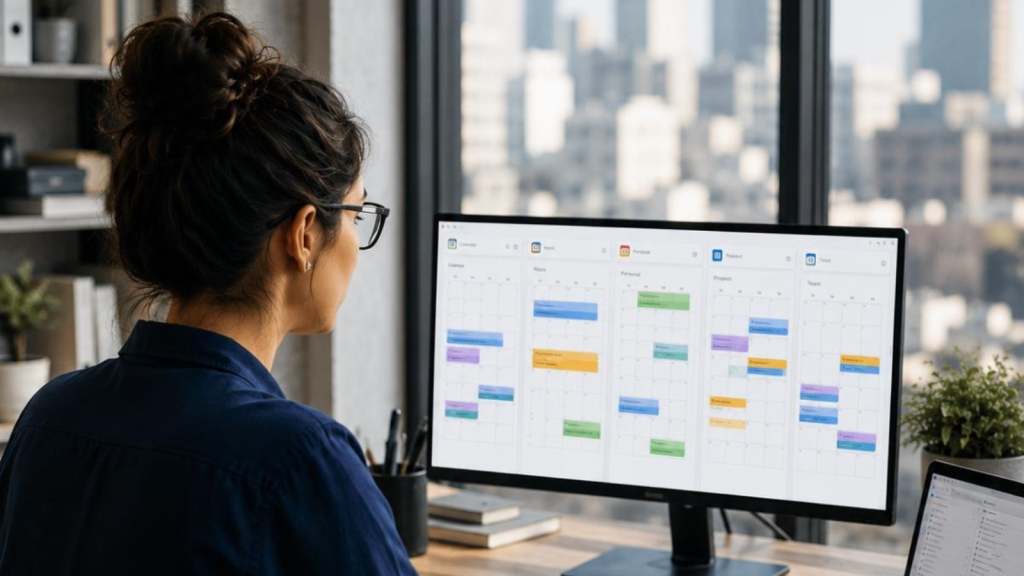
While work no longer happens in one place, most digital calendars still operate as if it does. Professionals involved with multiple companies often find themselves coordinating between separate systems, manually copying meetings across accounts, and trying to avoid double booking meetings. Additions or updates in one calendar sometimes fail to transfer to another, risking embarrassing conflicts.
Traditional calendar management tools typically show availability within a single platform. The reason is that these were designed for employees working within one organization, not a new generation of professionals that require cross-company scheduling or enterprise scheduling. The struggle of manually syncing calendar accounts, or duplicating events between systems, is not only frustrating; it’s an expense of time and energy that most executives don’t have.
Cross-platform calendar syncing
“Fractional executives need to have a single calendar that streamlines everything in one place,” says Paul Everton, Executive Chairman of CalendarBridge.Since 2020, CalendarBridge has developed calendar synchronization software used by organizations managing multiple calendar systems.”
This past May, CalendarBridge reported that more than 100,000 of its users had set up calendar synchronization, with over 4 million events synced across platforms.
Everton says that effective l SaaS software in this area should be easy to use and secure. It should provide calendar syncing across diverse platforms including Google, Outlook, Office365 and iCloud. Busy executives often seek tools that reduce the need to coordinate among multiple platforms,, so another feature should be a unified calendar that combines everything into a single interface with the ability to view, edit and manage every calendar connected to their account. It should allow users to schedule meetings quickly by sharing a link to their availability, assisted by an AI scheduling assistant, while helping protect privacy by allowing users to share availability without exposing sensitive details.
The era of spending an entire career with a single employer may be less common than it once was. As more professionals divide their time among multiple organizations, managing schedules across different systems has become a growing operational challenge. In response, organizations and software providers are developing tools and processes designed to help professionals coordinate their time more effectively across multiple workplaces.
The post The multi-calendar professional is the new normal appeared first on Digital Journal.
The multi-calendar professional is the new normal
#multicalendar #professional #normal