Devenex launches the Execution Control Plane for Enterprise AI
Opinions expressed by Digital Journal contributors are their own.
Built for the agentic era, Devenex governs enterprise actions before they execute – giving regulated organizations the authorization, identity binding, and audit-grade evidence that AI deployment now demands.
In regulated enterprise technology, the newest product rarely wins on novelty alone. Buyers want to know who will stand behind the system when compliance, operations, and liability are on the line.
That is the credibility argument behind Devenex, a standalone Execution Control Plane built for the agentic era, founded by Abacus, the global enterprise technology group with nearly 40 years of experience, more than 5,000 resources across four continents, and 1,500+ enterprise clients.
AI agent governance is not an ordinary software category. It sits too close to the actions that affect enterprise systems. A product in this space is not simply helping teams analyze information or organize tasks. It is governing whether actions are allowed to proceed across environments where mistakes can carry financial, regulatory, operational, and reputational consequences.
“Governance infrastructure has to be trusted before it can be adopted,” says Aly Kuly Khan, Co-Founder and Chairman of Devenex. “Regulated enterprises are not buying novelty. They are buying confidence that the system can hold under real operating pressure.”
That trust foundation is one of the reasons Devenex enters the market differently from many AI-era products. The company is positioned as a standalone brand, but it is backed by Abacus’s long history delivering enterprise technology, outsourcing, and people solutions across complex environments. The distinction matters. Devenex is not leaning only on a product thesis. It is supported by an organization with decades of enterprise implementation experience.
For enterprise buyers, that history is not decorative. It is part of the risk calculation.
Financial services, insurance, healthcare, public sector, and regulated technology organizations often carry strict security requirements, audit expectations, and internal governance controls. They do not have the luxury of treating AI agent oversight as an experiment. If agents and automated processes are going to act across systems, the layer governing those actions has to be credible from the start.
“Devenex was built for environments where accountability is not optional,” Aly says. “That is where Abacus’s background matters. The organization understands how large enterprises evaluate trust, delivery, compliance, and operational control.”
The timing is critical because agentic AI is pushing enterprises into a new phase. Agents are beginning to act across platforms and systems, moving from assistance into execution. They can trigger workflows, modify records, initiate approvals, and interact with the enterprise stack in ways that create real consequences.
As those consequences grow, governance moves from a helpful feature to mission-critical infrastructure.
Shoaib A. Khan, Co-Founder and CEO of Devenex, sees the challenge through implementation reality. Enterprises already have many controls around identity, access, workflow, integration, monitoring, and security. Those controls matter, but they were not designed for the full challenge of governing AI agents and other execution sources before actions move through the business.
“In real enterprise environments, governance has to work across systems that were not designed at the same time or in the same way,” Shoaib says. “That is why the control layer has to fit the architecture enterprises already run.”
That long view matters because Abacus has helped enterprises manage several generations of technology change. Each shift brought new questions about control, reliability, integration, and accountability. Devenex applies that institutional memory to the agentic AI era.
“The control model has to evolve when the operating model changes,” Shoaib says. “AI agents are not just another application category. They introduce execution behavior that has to be governed before it becomes part of the enterprise record.”
That is the role Devenex was built to serve. The platform governs actions before execution across AI agents, human operators, automated processes, and system events. It is designed to sit across enterprise environments rather than replace the systems enterprises already use.
That point is central to its enterprise credibility. Large organizations rarely have clean, simple stacks. They operate across systems of record, identity providers, cloud platforms, integration layers, legacy applications, and regulated workflows. A governance layer that requires wholesale replacement becomes its own adoption risk.
Devenex’s System-of-record neutral and cloud-native design is intended to avoid that problem. It governs across existing environments and supports SaaS, hybrid, and self-deployed deployment models. That flexibility allows enterprises to adopt within their own security perimeters and procurement realities.
“Governance infrastructure has to respect the architecture enterprises already run,” Shoaib says. “If the control layer only works in a perfect environment, it will not survive real deployment.”
That is especially important for organizations with strict data, security, and regulatory requirements. A financial institution, insurer, public agency, healthcare organization, or regulated technology company may need different deployment models depending on where sensitive systems sit and how internal controls are structured. Devenex was built to meet those adoption constraints rather than force a single model.
The product’s architecture centers on pre-execution governance. A regulated enterprise does not only need to know what happened after an action. It needs to prevent ungoverned execution and prove that policy evaluation occurred before action moved forward.
Devenex’s four-artifact model, Canonical Plan, Authorization Record, Execution Trace, and Evidence Pack gives enterprises the Decision to Execution Lineage needed for review without forcing teams to reconstruct the record later.
That model is designed to support compliance needs around the EU AI Act, SOC 2, and ISO 42001. Devenex is not presented as the certification itself. It is the infrastructure layer built to help organizations demonstrate governed execution under those frameworks.
“Enterprise AI governance cannot depend on reconstructing the story later,” Shoaib says. “The evidence has to be generated through the control process itself.”
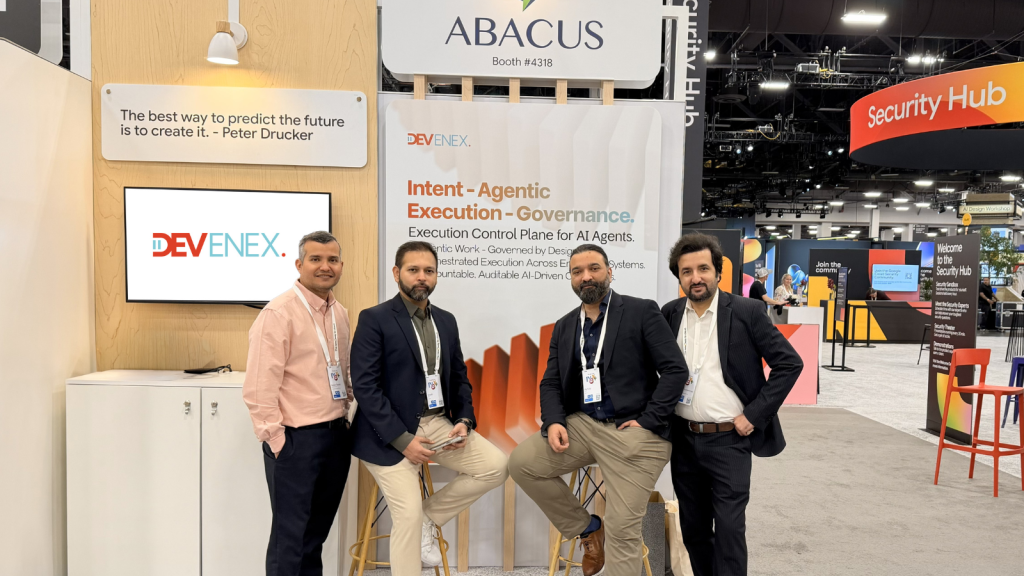
Its April 22, 2026 launch at Google Cloud Next added a public market signal to the institutional credibility already coming from Abacus.
The agentic era will not be shaped only by model capability. It will be shaped by whether enterprises trust the systems around execution. Regulated organizations will need more than speed, automation, and intelligence. They will need authority, proof, and institutional confidence around every action that touches the business.
That is the role Devenex is built to play, with Abacus as the trust foundation behind it.
“AI agents will only scale in regulated enterprises when leaders trust the infrastructure around their actions,” Aly says. “Abacus gives Devenex the delivery foundation those environments require.”
Devenex launches the Execution Control Plane for Enterprise AI
#Devenex #launches #Execution #Control #Plane #Enterprise