Upstate, suburbs fuming as cash-hungry NYC gets Hochul bailout and gobbles up state budget talks
They have budgetary FOMO.
Sidelined pols outside the Big Apple are frustrated that the cash-hungry metropolis is gobbling up attention amid ongoing state budget talks — as their own cities and towns starve for funds.
Some state lawmakers have even tried to emulate Mayor Zohran Mamdani, whose high-profile demands to help close a $5.4 billion budget shortfall in New York City have extracted concessions from Gov. Kathy Hochul, notably a proposed pied-à-terre tax on expensive second homes in the city.
Democrat Paul Feiner, longtime town of Greenburgh supervisor in Westchester, said he understands the attention heaped on the Big Apple — to a point.
“At the same time, we’re concerned about issues in the suburbs,” he said. “We have roads that are in total disrepair. The road conditions are so bad they have to be rebuilt. These are state roads!
“The state legislature doesn’t put enough money in the budget for the maintenance of their own roads.”
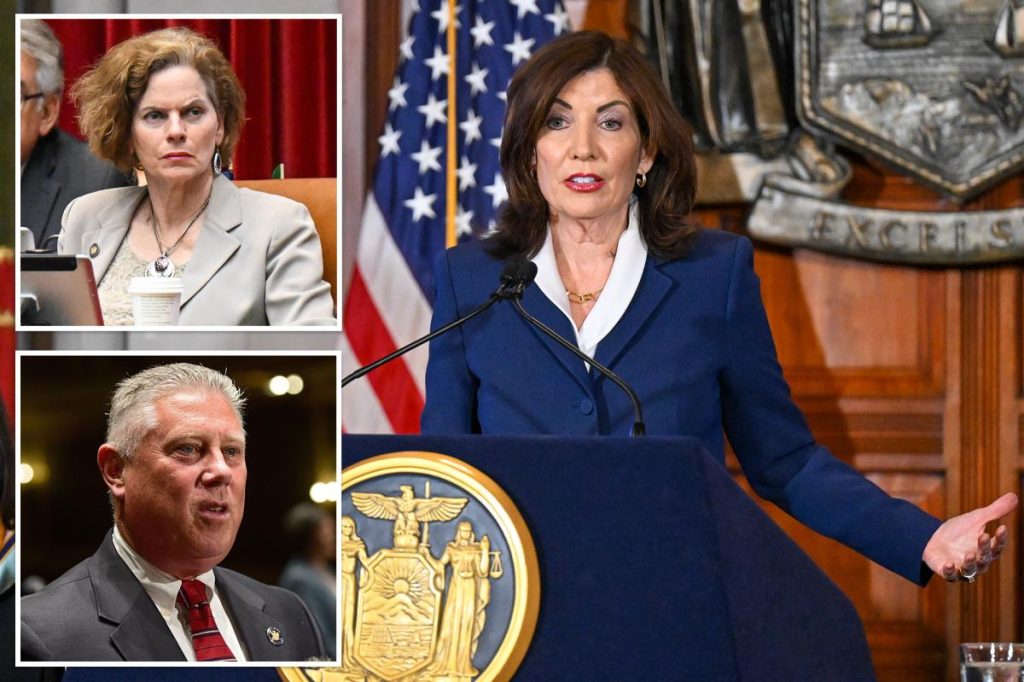
Hochul and Albany lawmakers blew past an April 1 deadline to pass the state budget amid impasses over the governor’s twin pushes to reform car insurance and to delay New York’s controversial climate law’s mandates.
But the lion’s share of public focus on Hochul’s proposed $263 billion budget has revolved around Mamdani’s push to effectively bail out the city, preferably by achieving his socialist dream of taxing the rich.
Hochul has so far held firm against calls to “tax the rich,” but she did give Mamdani a partial $1.5 billion bailout. She also last week proposed a yearly surcharge on second homes in New York City worth $5 million or more, known as a pied-à-terre tax.
Many specifics on the tax remain unclear, but sources have said rates likely would be set on a scale based on property sale values. Vacant and vacation homes would be targeted, while rentals or owner-occupied homes would be spared, officials said.
Mamdani’s seeming success at pushing for a tax increase prompted state Sen. Patricia Fahy, a Democrat who represents Albany, to push for a similar levy upstate.
“I’m not trying to be divisive. New York City is the economic driver of the state. I’m bringing attention to a host of needs. Let’s help upstate as well,” she said.
“We should have an option to tax second homes.”
Thousands of homes in areas such as Saratoga and Lake George have been converted into Airbnbs/short-term rentals, Fahy said.
She proposes an “opt-in” for the pied-à-terre tax on expensive second homes or investor homes outside Gotham — with half its revenues going toward a state fund for towns and village, and the other half directly going to where it’s imposed.
“We have so many villages that are hurting,” she said.
New York City isn’t the only major Empire State city potentially getting extra funds or revenue-raising goodies in the upcoming budget.
Cash-strapped upstate cities such as Buffalo, Rochester, Syracuse and Albany are all up for increased funding.
Assemblyman John McDonald (D-Albany) disagreed that the budget talks are revolving around the Big Apple.
He noted the two major sticking points on the budget – auto insurance and the climate law – arguably impact upstate more than the city.
“I think the attention is giving the impression that it’s all New York City-centric, and I hear that from my constituents,” he said.
“From my perspective as being a member who’s in the conference, who hears what our leadership is negotiating with the governor, she’s trying to strike a balance for both the city and non-New York City. We agree with striking that balance. However, we have no control over how people perceive striking that balance.”
But some local pols in smaller municipalities looked askance at Mamdani seeking more taxpayer money for New York City.
“I’m bothered by the fact that we’re bailing out New York City,” said Anthony Colavita, the Republican supervisor the suburban town of Eastchester — just a few miles north of the Bronx.
Colavita argued Mamdani isn’t tightening the city’s belt by reining in spending. The new mayor is just asking for more money, he said.
“What is the city doing to help itself?” he said.
“We’re sending money to Albany and giving it to entities that are not managed well. You keep spending money without restraint, and you run out of money.”
Source link