Would you buy branded clothing from your favourite tech firm?
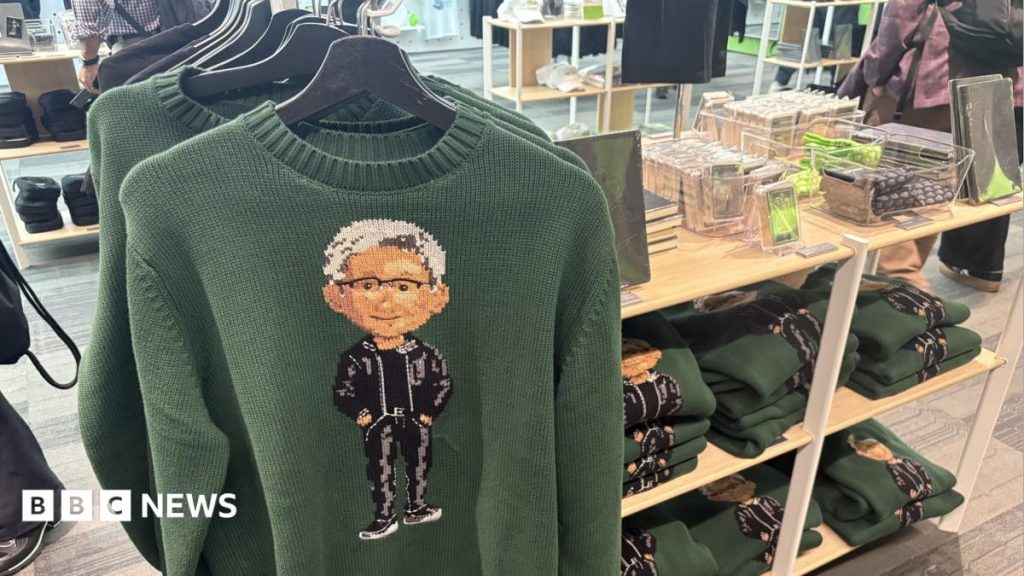
For Natalie Fratto, putting on her dark green jumper from US microchip giant Nvidia is like wearing the kit from a favourite sports team.
On the front of the $178 (£132) woollen garment is a cartoonish image of the tech company’s boss Jensen Huang.
Fratto doesn’t work for Nvidia. Instead, she’s a fan of the company.
“I have a New Zealand All Blacks rugby jersey, and I think of my Jensen sweater in kind of the same way,” says New York-based Fratto, who runs a tech start-up.
She explains that it’s a representation of a team and ethos “that I am impressed by and root for”, and she proudly wears the jumper in videos she posts on social media., external
Nvidia certainly plays in the top league of global tech firms. Under Huang’s leadership, it has capitalised on the AI boom to become one of the world’s most valuable companies.
While it sells tens of millions of its chips per year, its clothing is far more exclusive. The lines, which also include t-shirts, hoodies and hats, are typically only available to buy from pop-up stalls at its conferences, and for very limited periods or “drops” via an online store and sell out very quickly.
And while it might seem odd that such a tech company is selling clothing, others are getting in on the act too – and also focusing on exclusivity.
OpenAI, the operator of ChatGPT, usually only offers its branded fashion to employees, but occasionally it goes on general sale for a few days via its website.
Meanwhile, Anthropic, the maker of the Claude chatbot, last year opened a temporary, pop-up coffee shop in Manhattan’s West Village. For just one week it gave away free baseball hats with the word “thinking” embroidered on the front.
Professor Hazel Clark, who teaches fashion at Parsons School of Design in New York, says that by limiting availability, tech firms have taken inspiration from the world of fashion. “It’s a very common strategy for brands to use. It elevates the desirability,” she says.
But why are such companies selling clothing in the first place? It is not as if they need the supplementary income streams.
Nvidia, OpenAI and Anthropic all declined to comment, but it appears to be about brand promotion and reputation management.
Take US software firm Palantir Technologies, which has faced criticism due to it work for the military and police, both in the US and overseas. Since launching its own clothing range last year, Palantir now calls itself a “lifestyle brand”.
Eliano Younes, Palantir’s head of strategic engagement, says: “A lifestyle brand isn’t defined by what you sell, it’s defined by what you stand for and whether people want to affiliate with it. I believe that the store’s success and the enthusiasm from our community proves this.”
Younes adds that “investors, customers, employees, and everyday people” in more than 60 countries have bought Palantir’s gear, which includes a cotton jacket.
Source link