Canada and Germany show what a middle-power AI bet looks like
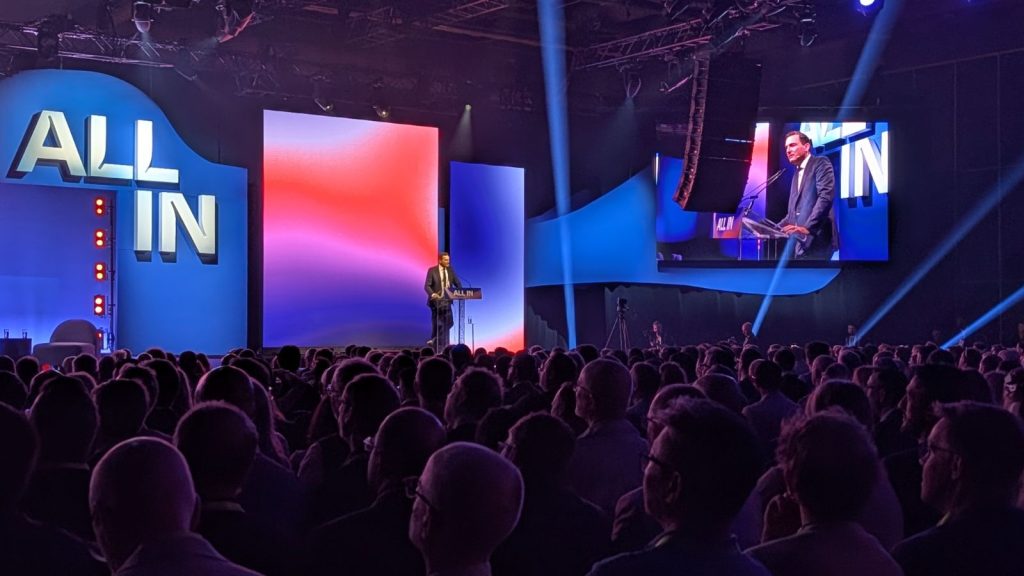
At ALL IN, Solomon graded Canada’s year of AI policy and put the Germany alliance on display.
A year ago, Evan Solomon stood on the ALL IN stage and told the founders, researchers and investors that Ottawa would match their ambition to make Canada a world leader in AI.
Kicking off the event today, he came back to grade the work.
Canada’s minister of artificial intelligence and digital innovation opened ALL IN with a report card on 12 months of policy, and a single argument running underneath it: A country the size of Canada can still set its own terms in a technology dominated by the United States and China, as long as it doesn’t try to do it alone.
“If we don’t build it here, we have to buy it from someone else, and if we don’t innovate here, we have to rent it from someone else, and if we don’t make the rules here, we have to follow someone else’s,” Solomon said.
Now in its fourth year, ALL IN runs Sept. 16-17 at Montreal’s Palais des congrès. Organized by Scale AI, one of the federal government’s innovation clusters, the conference drew more than 9,000 people from more than 50 countries.
Germany is this year’s country of honour and Canada’s partner in the Sovereign Technology Alliance, an AI and digital pact the two countries signed in February.
Building with allies instead of alone was the theme of the whole morning, and opening the conference alongside Germany put it front and centre.
It’s the same argument Prime Minister Mark Carney made at Davos earlier this year, when he declared the U.S.-led global order over and told smaller economies to fend for themselves against great-power coercion.
“Middle powers must act together because if we’re not at the table, we’re on the menu,” Carney told the forum in January.
Two middle powers joining forces is a real sign of democracies outside the U.S. building their own weight in a technology America and China expect to control.

Canada and Germany bet on trust over scale
Canada’s bet has a name and a partner. Canada and Germany built the Sovereign Technology Alliance to work together on AI and digital technology, across computing infrastructure, safety, talent and commercialization.
ALL IN is where they showed what has come of it.
In the months since, Germany has stood up its own AI security institute and begun working with Canada, the U.K. and France to test AI models. More than 30 German companies came to Montreal to do business with Canadian counterparts. Ottawa signed a letter of intent to fund LawZero, the AI safety non-profit founded by Yoshua Bengio, during Solomon’s February trip to Germany. And on the same stage this week, Cohere and Germany’s Aleph Alpha announced they have finalized their merger, combining into a single company.
The conference is about tech, but Wildberger’s closing remarks showed the relationship runs deeper than AI. From the stage, he thanked Canada for naming Germany’s TKMS its preferred supplier for the next submarine fleet, a defence deal that shows how far the trust now goes.
The friendship also serves a purpose.
Both Canada and Germany are G7 democracies with strong research, but neither can match the compute or capital of the U.S. giants alone. Germany is the world’s third-largest economy and Canada’s researchers pioneered modern AI, yet apart they remain customers of the American and Chinese systems they helped make possible. Together, they have a shot at building their own.

Karsten Wildberger, Germany’s minister for digital transformation, made it personal.
“From our very first conversation, I felt we could speak openly and trust each other,” he said. “Thank you for your friendship and for everything we are building together.”
Solomon returned the praise.
“[Wildberger] is a trusted ally, and Germany is our trusted ally,” Solomon said. “But more than anything, he is a friend, and that is important in this world. Trust and friendship matter.”
Solomon tied it back to Canada’s pitch to the world.
“We have the most precious commodity in the world: trust,” Solomon said. “When we say we will do something, we do it.”
Later, on a panel moderated by CBC’s Catherine Cullen, Solomon returned to the word the strategy is built around.
“We don’t want people to have to choose between a hegemon and a hyperscaler,” he said. “There are more choices. That’s why we say sovereignty is choice.”
Asked what that means for the businesses in the room, he drew the line at data.
“Your most precious information and data is subject to Canadian law, not subject to the coercion of anyone else. Full stop,” Solomon said.
For Wildberger, sovereignty only counts if there’s a real alternative to the giants.
“A choice is only real if you have an alternative,” he said. “Sovereignty doesn’t mean solitude. It means the strength to cooperate on equal terms.”
Cohere co-founder Aidan Gomez, on a panel with both ministers later in the morning, made the case in national terms. He argued that a world depending on a handful of American firms is fragile, and that democracies outside the U.S. have to build a second option.
“If there isn’t a second democratic rail to that project, it’s a threat to the entire democratic project,” Gomez said.
He pointed to the federally funded research behind Yoshua Bengio and Geoffrey Hinton, whose work in Canada laid the foundation for today’s AI.
“Not enough Canadians know that we invented this. This is our technology,” Gomez said. “We should be the ones to bring this technology to the world stage.”
Solomon said Canada is also helping push for an international body to test and evaluate frontier AI models, an idea Carney has discussed with German Chancellor Friedrich Merz and French President Emmanuel Macron.
“The appetite for regulation and cooperation is growing, not receding,” he said.

Canada’s report card
Back home, Solomon came with receipts. He built the scorecard around the three goals of the national strategy his government released in June, AI for All:
- Trust: earning public confidence in the technology
- Opportunity: spreading its benefits across the country
- Sovereign control: keeping Canada in charge of its own AI
The government says the plan will add $200 billion to the economy and create 250,000 jobs by 2031.
“We are KPI people, we’re results-driven, so I’m going to report the results,” Solomon said.
On trust, he pointed to $50 million to expand the Canadian AI Safety Institute and four pieces of AI legislation the government moved this year. They criminalize non-consensual sexual deepfakes, ban AI deepfakes in elections, restrict social media for children under 16 while bringing AI chatbots into the rules, and replace Canada’s 26-year-old private-sector privacy law. Two are now law. The social media bill and the privacy overhaul were introduced before the summer break and have not passed.
The privacy bill would create what Solomon called “a regulator with teeth, for the first time in Canadian history,” able to fine large technology companies billions of dollars. That legislation, he acknowledged, is still on the table.
Solomon returned repeatedly to a phrase from his keynote, that the job is to “build right.” The conference opened against a live argument among researchers and frontier labs over whether AI could one day threaten humanity, and Solomon met it directly.
“We take those risks and concerns seriously, profoundly, and deeply,” Solomon said, pointing to the safety institute, the legislation and the work of Montreal’s Mila.

On sovereign control, he put infrastructure first.
Earlier this month his department released a five-point framework for building data centres, worked out with the Federation of Canadian Municipalities, which represents about 2,200 communities. The principles say a project cannot raise local power rates, has to limit water use, and must deliver community benefits. Solomon said more than 40 companies have signed on. The version his department published lists 23, among them OpenAI, Anthropic, Google, Microsoft, Amazon, Bell, Telus and Cohere.
Solomon also said the government more than doubled its Compute Access Fund, which subsidizes computing costs for Canadian firms, to $700 million, and that it will announce the results of a separate billion-dollar public supercomputer this fall.
Under the opportunity pillar, Solomon said the plan puts $1.5 billion into small and medium companies, split three ways:
- $500 million through the Business Development Bank’s LIFT program
- $500 million through regional development agencies
- $500 million through a fund in which the government will take equity.
He pointed to another $400 million for health technology and $100 million for privacy-preserving health data.
The government also launched a $13-million national AI literacy program last week, delivered by Edmonton’s Alberta Machine Intelligence Institute (Amii), that it says will reach a million post-secondary students and 50,000 teachers, with courses opening Sept. 21. Solomon said Ottawa will give every post-secondary student in Canada free access to a trusted AI agent for five years.
Final shots
- Two of the four bills still have to pass, the billion-dollar supercomputer gets its result this fall, and the student AI agent has no vendor, cost or delivery date yet.
- Adoption is the number Ottawa controls least. Statistics Canada put the share of Canadian firms using AI at about 12% last year, and the year’s announcements haven’t moved it yet.
- Germany is the first real test of the middle-power doctrine Carney laid out at Davos. Solomon is betting others follow, and Wildberger used the stage to invite them, telling the room he hoped many more partnerships like this one would start at ALL IN.
Canada and Germany show what a middle-power AI bet looks like
#Canada #Germany #show #middlepower #bet