Nursing homes now cost $129,575 a year. Mike Link and KamiCare are betting on the alternative.
Opinions expressed by Digital Journal contributors are their own.
You have spent a working life building something. A career, a home, a family. Then at some point the question arrives that nobody prepares you for, which is how to stay safe in your own house without surrendering the independence that took decades to earn.
The senior care industry has long presented two answers: an expensive facility, or round-the-clock help at home. A third option has been forming in the background, and the economics are what make it interesting.
The math facing retirees in 2026
The numbers are unforgiving. Nursing homes with private rooms now run a national median of $355 a day, roughly $129,575 a year, according to CareScout’s 2025 Cost of Care Survey. Assisted living, frequently marketed as the affordable alternative, averages $6,200 a month, or $74,400 annually.
The trajectory matters as much as the level. Assisted living costs rose 10 percent in 2024 and another 5 percent in 2025, outpacing general inflation across that stretch even as overall care cost growth began to moderate, and eroding retirement savings that were built for a different cost curve.
Preference has been pointing the other way for years. AARP’s Home and Community Preferences Survey has found that 77 percent of adults 50 and older want to remain in their homes as they age, a figure AARP notes has held steady for more than a decade. Its December 2024 update puts the number at 75 percent across all adults 18 and over.
For many people now approaching those decisions, the resistance is not only financial. They watched their own parents move into institutional settings and remember what it cost in privacy and identity.
Why the floor is the real risk
Falls are the reason most aging-in-place plans fail, though not for the reason people assume.
According to CDC data updated in January 2026, more than one in four adults aged 65 and older falls each year, producing roughly 3 million emergency department visits and about 1 million hospitalizations annually. Falling once doubles the likelihood of falling again.
Set those figures side by side and something becomes clear. Most falls do not end in hospitalization, since 1 million hospitalizations sits against a far larger number of falls. The acute danger is frequently not the impact. It is lying on the floor for hours with no way to summon help.
That is the specific failure Kami Vision built KamiCare to address. The San Jose company, where Mike Link serves as chief operating officer, brought its at-home AI fall detection camera to market at CES 2025 after several years deployed inside senior living communities.

What KamiCare actually does
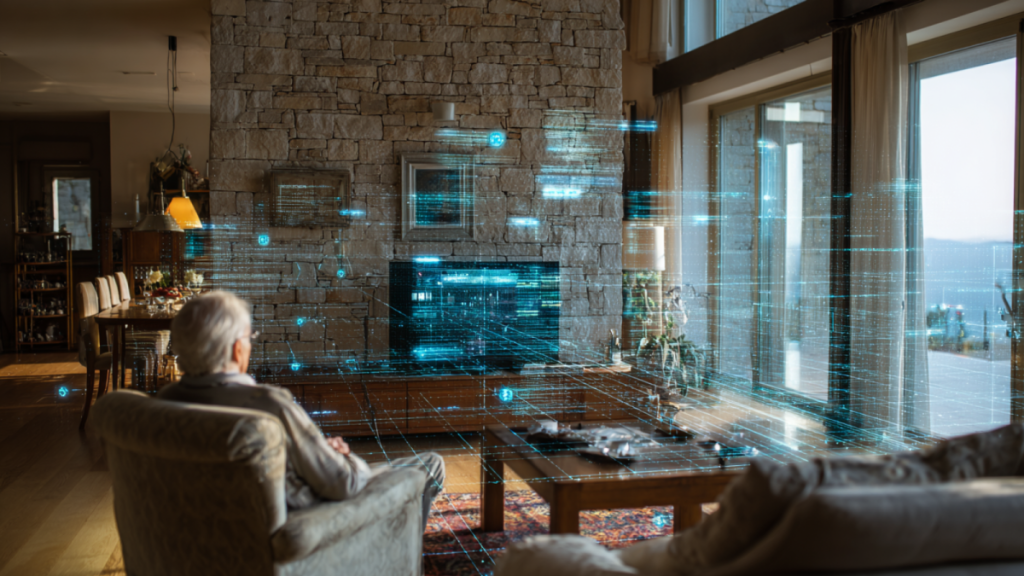
The distinction from a standard security camera is contextual understanding. A motion sensor registers movement. KamiCare’s on-device processing is trained to recognize a fall specifically, then trigger a response without requiring the person on the floor to do anything.
The escalation runs in sequence. When the system identifies a fall, the alert goes first to the individual, giving them the chance to respond and confirm they are fine. If no response comes, it escalates automatically to emergency contacts designated during setup, who can reach emergency services directly through the app.
That sequence is the meaningful departure from medical alert pendants, which depend on an injured, disoriented or unconscious person pressing a button, and from wearables that have to be remembered and charged.
The number behind the claim
Kami Vision reports 99.5 percent fall detection accuracy, and the provenance of that figure deserves stating plainly.
It comes from the company’s own internal testing, drawn from more than 3,700 real fall incidents recorded across senior living deployments in 2023, including cases where furniture partially obscured the camera’s view. It reflects company testing and has not been independently verified.
Link has said the underlying methodology documentation, covering how accuracy was defined and how false positives and negatives break out, is being compiled by the engineering team. For anyone evaluating this category, that is the right question to ask of any vendor citing a performance number, and the willingness to answer it is itself a useful signal.
Privacy by design, not by promise
Any camera inside a home raises legitimate objections, particularly one monitoring an older adult who may not have chosen it themselves.
Kami Vision’s answer is architectural rather than reassuring. The system records only when an incident is detected rather than continuously. Professional reviewers see blurred, anonymized clips. Unobscured footage is accessible only to explicitly authorized contacts.
The distinction worth drawing is between surveillance imposed on someone and a tool selected by the person it protects. That difference tends to determine whether the technology gets used at all, since a system a resident resents is a system that gets unplugged.

What aging in place actually requires
The assumption that aging necessarily means facilities and dependence reflects outdated defaults more than biology. Roughly one in ten adults over 65 has dementia, according to a 2022 JAMA Neurology analysis, and the Alzheimer’s Association’s 2026 Facts and Figures report puts it at about one in nine for Alzheimer’s specifically. Either way, the overwhelming majority of older adults, including well into their 80s, are living with their cognitive faculties intact.
What that majority needs is not institutional care. It is infrastructure that preserves choice.
Kami Vision is building toward that in layers. Beyond the camera, the company is developing Vision AI for assisted living applications and a wearable smart ring tracking heart rate, sleep and blood oxygen, which extends monitoring into spaces a camera cannot reasonably cover.
KamiCare first reached senior living communities and care facilities in early 2022 and expanded across the sector through 2025, with a consumer version developed and beta tested in homes across the United States during that period. Families weighing options for a parent can see current availability, pricing and setup requirements at kamivision.com.
For the generation that has rewritten every life stage it has entered, the alternative to a $129,575 annual bill is no longer theoretical. It is a question of whether the supporting technology is good enough, and how honestly its makers are willing to talk about it.
Kami Vision’s fall detection technology is a safety and monitoring aid. It is not a medical device, is not intended to diagnose, treat, or prevent any medical condition, and does not replace medical care, professional caregiving, or emergency services. Anyone experiencing a medical emergency should contact emergency services directly.
Nursing homes now cost $129,575 a year. Mike Link and KamiCare are betting on the alternative.
#Nursing #homes #cost #year #Mike #Link #KamiCare #betting #alternative