Adaptive reuse is redefining the future of construction
This article has been reviewed by a Digital Journal editor and may be licensed for reuse.
Across the United States, property owners, developers, investors, and policymakers are increasingly examining whether underused buildings can be adapted to meet changing market needs. The shift is particularly visible in commercial real estate, where persistent office vacancies have coincided with a severe shortage of housing. A 2025 Brookings analysis of office-to-residential conversions found that the changing nature of office work and the persistent U.S. housing crisis are motivating local governments and owners of underutilized office buildings to consider converting offices into housing.
The Urban Land Institute describes adaptive reuse as gaining momentum as property markets confront challenges including housing shortages, rising office vacancies and climate concerns. Its research examines adaptive reuse projects in markets including Kansas City, Boston and Lisbon, illustrating how the approach is being applied across different real estate markets.
The Commercial Real Estate Development Association’s research on office conversions notes that the post-pandemic shift toward remote work has contributed to changes in the office market and growing amounts of vacant and underused commercial space, while identifying conversions as a potential way to expand housing and reinvigorate affected communities. At the same time, the feasibility and cost of conversion depend on factors including a building’s physical characteristics, regulatory requirements, location, and the extent of required retrofitting.
The U.S. Environmental Protection Agency identifies adaptive reuse as a way of redesigning existing buildings for new functions while preserving the historical and social fabric of a place. It also notes that renovating existing buildings can provide a more sustainable alternative to redevelopment because land clearing, demolition, and the production and transportation of new construction materials generate carbon emissions associated with embodied carbon.
In New York, the result is a convergence of pressures: a severe shortage of rental housing, a changing commercial real-estate landscape, new incentives for conversion and growing attention to the value embedded in the city’s existing building stock.
For Tallal Bhutta, CEO of BDB Construction Enterprise, that convergence has made adaptive reuse an increasingly important part of the construction landscape. His background spans civil engineering, structural engineering, construction management and field construction, informing an approach centred on understanding an existing structure before determining how it should be modified.
“Adaptive reuse begins with respect for the building that is already there,” Bhutta says. “Before we decide what the building should become, we have to understand what it has been carrying, how it has been altered, and how those conditions affect the work ahead.”
That distinction matters because an existing building presents a different set of variables from a project constructed from the ground up. “Drawings may not fully capture subsequent alterations, structural elements can have been modified over time, and mechanical, electrical, and plumbing systems may have been installed or replaced across different periods. Once demolition begins, previously concealed conditions can influence sequencing, costs, and the engineering required to accommodate a new use,” he adds.
BDB’s experience provides a practical example. In a Bronx project documented by Engineering News-Record, the company transformed an industrial building into a church and community-oriented commercial space. The work involved structural reinforcement, new steel, strengthened floor decks and modifications to accommodate new stair and elevator openings, alongside extensive mechanical, electrical and plumbing work. The project illustrates how conversion can require existing structures to be investigated and strengthened while new systems are integrated into the building.
“Every probe is a conversation with the building,” Bhutta says. “The earlier that conversation happens, the more useful the information becomes. It gives owners, designers, and contractors a common basis for deciding how the project should proceed.”
According to him, the structural dimension becomes particularly important when a conversion requires new elevator shafts, floor openings, reinforced members, or additional stories. Bhutta notes that altering an existing building can change how loads move through its structure, making coordination between demolition, engineering, and new construction critical.
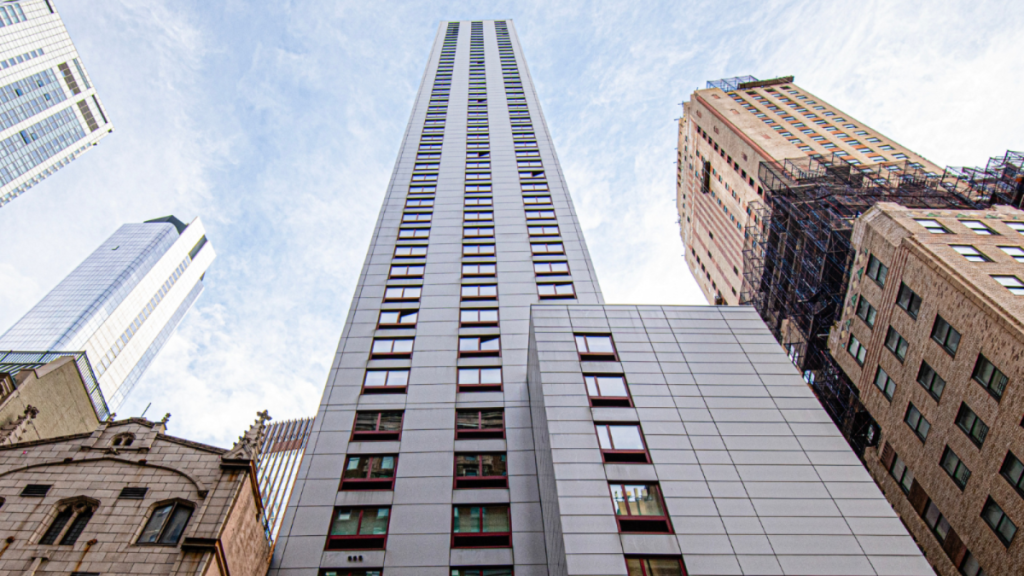
A recent example in Midtown demonstrated the potential consequences of that complexity. The former Pfizer headquarters at 219 East 42nd Street became the subject of scrutiny after structural steel columns buckled during a conversion project that involved adding several floors to an existing building. Associated Press reporting described the incident and the engineering questions surrounding the addition of new loads to an older structure.
Bhutta’s own career has given him experience across several sides of construction. According to BDB, he began working through his family’s construction business before studying civil engineering and later earning master’s degrees in structural engineering and construction management. The company’s portfolio includes renovation and conversion projects involving industrial, commercial, and hotel properties.
“The commercial calculation behind adaptive reuse can be equally complex,” Bhutta says. “A project must account for the physical condition of an existing building, the requirements of its proposed use, structural and building-code considerations, the condition of its mechanical and electrical infrastructure, and the cost of bringing the property into compliance. At the same time, owners and contractors must manage the financial implications of conditions that may only become apparent once work is underway.”
Bhutta advocates a partnership-oriented approach to those decisions, with documentation and communication playing a central role when unforeseen conditions emerge.
“An unforeseen condition should create a problem-solving conversation,” Bhutta states. “The owner needs to understand the reason for the change, and the contractor needs to understand the owner’s financial objectives. When both sides see the project as a shared responsibility, the technical solution can become much more productive.”
According to him, that approach is particularly relevant in a market where adaptive reuse is increasingly being treated as a component of housing policy. The city’s Comptroller found that office conversions since 2020 had created a pipeline with the potential to produce approximately 17,400 apartments, the majority of them studios and one-bedrooms available for rent. The same analysis found that the 467-m programme is sustaining the wave of conversions and accelerating housing production, with tax exemptions for qualifying projects in Manhattan south of 59th Street estimated to be worth $5.6 billion in present-value terms.
The city itself is now using individual projects to demonstrate what that transformation can look like. At 5 Times Square, for example, the former Ernst & Young headquarters is being converted into as many as 1,250 rental homes, including approximately 313 permanently affordable units. The project is participating in the city’s Office Conversion Accelerator and is taking advantage of the new 467-m tax incentive programme.
For BDB, the broader shift places construction expertise closer to the centre of the development decision. “Adaptive reuse requires owners, designers and contractors to understand not only what an existing property could become, but also what its structure, systems and history will permit,” Bhutta says. “Buildings have economic lives that can extend beyond their original purpose. The opportunity is to understand the structure deeply enough that its modification becomes a realistic construction proposition.”
Adaptive reuse is redefining the future of construction
#Adaptive #reuse #redefining #future #construction