Canada’s farms are turning to robotics for efficiency and the employment gap
Canada’s agricultural sector is often discussed in terms of land, weather and commodities. Increasingly, however, it should also be understood through the lens of automation. Robotics is moving from novelty to necessity on Canadian farms, driven by labour shortages, rising input costs, climate pressures and the need to improve precision. The shift is not confined to one part of the country or one farming model: it is appearing in prairie grain production, Ontario dairy operations, British Columbia vegetable farms and high-value greenhouse horticulture. Yet the country’s robotics transition remains uneven. Canada has promising pilot projects, credible research capability and public funding channels, but adoption still lags behind what the technology could enable.
The structural case for robotics is partly economic: Agriculture and Agri-Food Canada reports that crop production had a 4.0 percent job vacancy rate in 2024, above the national average of 3.3 percent, while greenhouse, nursery and floriculture production also remains under labour pressure. The Canadian Agricultural Human Resource Council projects that more than 100,000 agriculture jobs could be vacant by 2030, with more than 85,300 workers, around 30 percent of the workforce, expected to retire over the same period. In that context, farm robotics is not best viewed as labour replacement; it is a tool for labour substitution where labour is scarce, and for labour augmentation where skilled oversight matters more than repetitive manual work.
Fragmented technological implementation
Canadian farming is more technologically intensive than many comparable countries. For example, Statistics Canada’s 2021 Census of Agriculture found that more than half of Canadian farms reported using at least one selected technology, with larger farms leading uptake as part of a broader modernization trend. The same Statistics Canada analysis also noted that robotic milking more than doubled between censuses, indicating that, in some subsectors, robotics has already crossed the line from experimental to operational. At the same time, the Canadian Agri-Food Policy Institute (CAPI) argues that digital-agriculture adoption in Canada remains fragmented, with larger operations more able to absorb costs and smaller farms more likely to be excluded from gains in productivity and sustainability.
The most visible examples come from broadacre farming on the Prairies, where autonomy is being layered onto existing machinery. Saskatchewan farmers are already using self-steering combines, self-driving grain carts, automated tillage and machine-guided crop monitoring. CBC’s reporting from Saskatchewan captures a central point: the operator is not removed from the process, but repositioned. The farmer becomes a manager of multiple data streams, supervising the machine rather than performing every movement manually. That redefinition is important. Robotics on grain farms often starts not with humanoid machines but with software-rich equipment that can optimize routes, reduce overlap, lower fuel use and improve accuracy across very large acreages.
Using machine learning to improve crop yields
There is also a strong economic logic in horticulture and specialty crops, where labour intensity is higher and the skill requirements of harvesting are more complex. In British Columbia, federal and provincial support through the B.C. On-Farm Technology Adoption Program has helped farms deploy technologies including robotic weeders, digital storage controls and fruit-picking platforms. One example highlighted by Agriculture and Agri-Food Canada is a machine-learning robotic weeder that distinguishes crops from weeds and selectively removes unwanted plants, helping reduce labour demand and herbicide use. Another funded orchard platform improves worker safety and fruit handling. These are modest but important examples of robotics and semi-robotics delivering practical value in real farm settings rather than remaining in demonstration facilities.
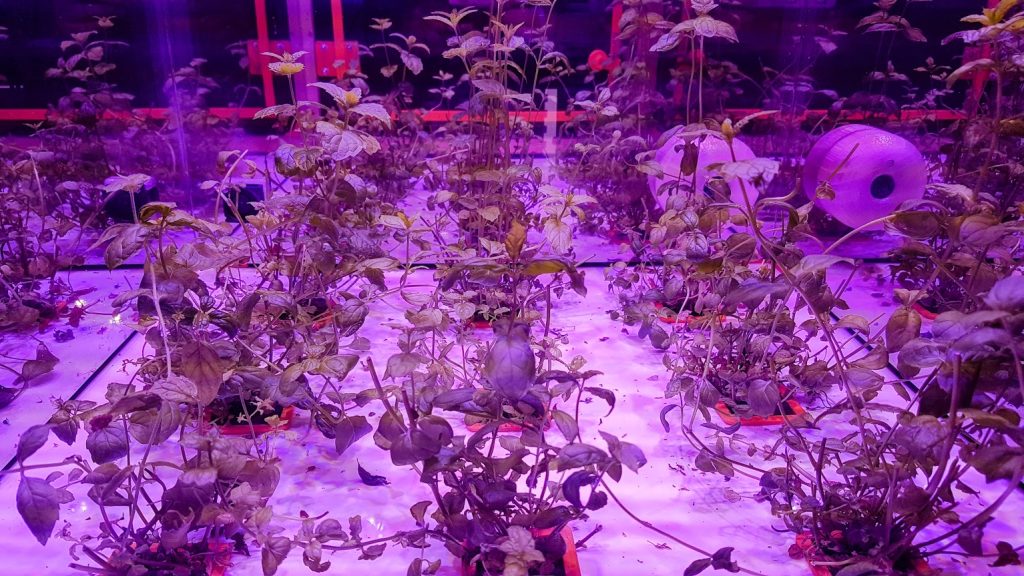
Greenhouse agriculture may prove to be the most important proving ground for next-generation farm robotics in Canada. The University of Guelph’s GIGAS system—a robot developed to identify and harvest tomatoes using AI-enabled vision and specialised grippers. This shows how Canadian research is targeting one of the most difficult problems in agricultural automation: handling variable biological materials without damaging them. The same platform has potential disease-detection applications, offering a route to earlier intervention and reduced chemical usage.
This is highly relevant to Ontario’s greenhouse sector, where labour intensity, year-round operation and high crop value make robotics particularly attractive. The challenge is that research breakthroughs do not automatically convert into affordable, serviceable commercial systems for growers.
Livestock farming presents a different robotics story—one that is more mature, and arguably more quietly transformative. Robotic milking systems are already reshaping dairy operations by shifting milking from labour-scheduled batches to continuous, data-rich, animal-level management. Returning to Statistics Canada, their finding that robotic milking adoption more than doubled is significant because it suggests that producers see a viable return on investment. In industry reporting from Alberta, dairy operators that have transitioned from rotary parlours to robotic milking describe the gains not only in labour flexibility but in cow-level data, including milk yield and early signs of health events. Here robotics is inseparable from biosensing, analytics and herd management software. The machine does not simply perform a task; it changes the decision environment of the farm.
Canada’s robotics future in farming is not guaranteed. CAPI’s 2025 report is blunt that digital agriculture has not yet been treated as a strategic national priority with sufficient coherence. The report identifies poor rural connectivity, uncertain return on investment and mistrust around data stewardship as barriers to wider uptake. Ontario-focused research adds further barriers: high upfront cost, scepticism, uncertainty and the practical difficulty of adapting technologies to varied farm conditions. These are not trivial implementation issues. A robot that performs well in a controlled trial may struggle under mud, shifting light conditions, heterogeneous crops, narrow windows for intervention, or insufficient technical support. Adoption depends as much on after-sales service, interoperability and training as it does on engineering.
Is the government in tune?
Public policy is beginning to respond, but not yet at the scale required. CAAIN, the Canadian Agri-Food Automation and Intelligence Network, continues to fund collaborative innovation in automation, robotics, data-driven decision-making and demonstration, and in May 2026 announced up to C$6.25 million from Agriculture and Agri-Food Canada, following a C$9 million agtech project competition launched in March 2026. That is a constructive signal, especially because translational funding—the difficult middle ground between research and market—is often what determines whether country-specific solutions ever reach farms. Yet Canada still needs a more coordinated robotics strategy linking incentives, workforce development, demonstration sites, connectivity and procurement logic. Otherwise, adoption will remain patchy and concentrated among larger, well-capitalized operations.
The labour question needs to be handled carefully. It is easy to frame robotics as displacing workers, but Canadian evidence suggests a more complex picture. Ontario research indicates that AgTech adoption is creating demand for programming, analytics and equipment-maintenance capabilities alongside traditional husbandry and agronomy skills. The Future Skills Centre similarly argues that automation will reshape one-third of agriculture jobs over the next decade, implying not wholesale elimination but significant transition in role content and skill mix. In short, the farm worker of the next decade may need to be as comfortable with diagnostics and data as with machinery and livestock. Robotics raises productivity, but it also raises the training threshold.
Robotics in Canadian farming is important not because it offers a futuristic image of autonomous agriculture, but because it offers realistic responses to current operational constraints. It can reduce repetitive work, improve precision, strengthen biosecurity, enable earlier intervention, reduce selected chemical inputs and make year-round or large-acreage systems more manageable.
Yet robotics is not a plug-and-play answer. The sector needs better connectivity, more translational funding, credible ROI models for medium-sized farms, stronger service ecosystems and a more explicit national policy commitment to digital and robotic agriculture. Canada has the research base and the agricultural need. The next question is whether it also has the implementation discipline to turn scattered innovation into a genuine productivity platform.
Canada’s farms are turning to robotics for efficiency and the employment gap
#Canadas #farms #turning #robotics #efficiency #employment #gap