A mathematical shortcut for measuring microplastics could transform river monitoring
Microplastics have become one of the most pervasive pollutants in the world’s waterways, yet measuring them remains curiously inconsistent. Now a team of researchers in Japan has proposed a way to sidestep one of the biggest challenges in the field: the impossibility of counting every particle.
In a study published in Environmental Pollution, scientists from the Tokyo University of Science demonstrate that it may be possible to estimate total microplastic contamination in rivers—even from incomplete datasets. Their approach relies on mathematical modelling to infer what cannot easily be measured directly, potentially opening the door to faster, cheaper and more standardised monitoring.
At first glance, the problem seems simple: collect water samples, count the plastics and report the results. In reality, the situation is far messier. Microplastics span a wide range of sizes—from fragments several millimetres across down to particles barely detectable with conventional techniques. Different studies use different sampling methods, filters and detection thresholds, making comparisons between datasets difficult, if not impossible.
The consequence is a fragmented picture of pollution. One study might report microplastic counts down to 300 micrometres, while another includes particles ten times smaller. Yet these tiny fragments are often the most biologically relevant, capable of entering tissues and potentially disrupting physiological processes. Missing them means underestimating both environmental load and potential risk.
The Japanese team, led by Mamoru Tanaka, approached the problem from a different angle. Rather than attempting to measure every size fraction, they asked whether it was possible to extrapolate the full size distribution from partial measurements. The idea is grounded in a principle already familiar in other branches of environmental science: many natural systems follow predictable scaling laws.
Using water samples collected from Japan’s Tsurumi River, the researchers applied three different sampling methods simultaneously, capturing microplastics across a range from 0.03 to 5 millimetres. They then analysed how particle numbers varied with size and found that the distribution could be described using a mathematical relationship known as a power law.
In essence, this kind of model predicts that smaller particles should occur more frequently than larger ones in a predictable way. If the relationship holds, then measuring a subset of particle sizes allows scientists to estimate the rest. The results suggest that both the number and mass of microplastics can be inferred with high accuracy from these partial datasets.
If validated more widely, the implications are significant. Microplastic surveys are notoriously labour-intensive, often requiring painstaking filtration, microscopy and chemical identification. Reducing the amount of direct measurement needed could lower costs, increase sampling frequency and make long-term monitoring programmes more feasible.
It also opens the possibility of standardisation. One of the enduring obstacles in microplastics research is the lack of harmonised methods. Without common baselines, it is difficult to compare rivers, regions or trends over time. A model-based approach, if robust, could provide a shared framework for interpreting diverse datasets.
Crucially, the study highlights the importance of the smallest particles—those below 200 micrometres—which are often overlooked in routine monitoring. These microplastics are the most likely to be ingested by organisms and have been detected in tissues ranging from fish to humans. By enabling their estimation without direct measurement, the model addresses a key blind spot in current surveillance.
Canada’s plastic pollution problem
For Canada, the findings arrive at a time of growing concern about plastic pollution in freshwater systems. The country’s vast network of rivers and lakes, including the Great Lakes basin, represents both a resource and a vulnerability. Studies have already shown that microplastics are present in Canadian waters, sediments and even drinking water systems, but comprehensive national datasets remain limited.
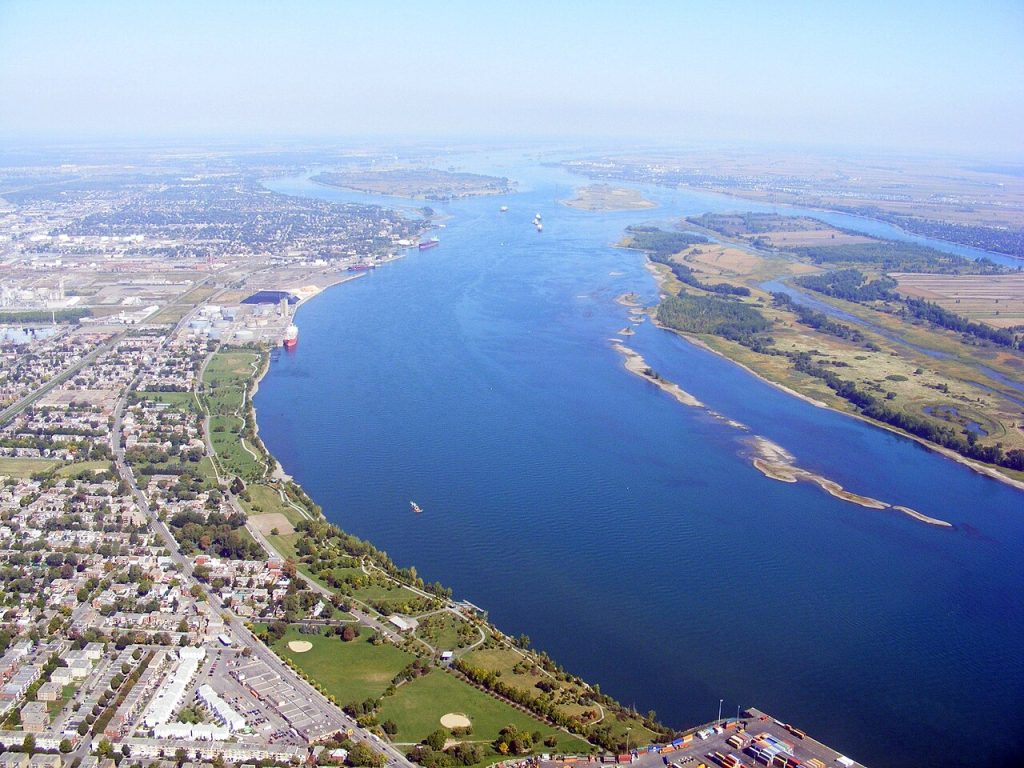
In the St. Lawrence River system, microplastics have been detected at 100% of sampled sites.
Monitoring in Canada faces the same methodological challenges identified in the Japanese study. Sampling across such a large geographic area is resource-intensive, and different research groups often use different protocols. This makes it difficult to build a coherent national picture of microplastic contamination or to track changes over time.
A modelling approach could therefore have particular value. By allowing researchers to estimate total microplastic loads from partial measurements, it could enable broader spatial coverage without a proportional increase in effort. In remote or northern regions, where logistics constrain sampling campaigns, this could be especially advantageous.
Adapting the Japanese power‑law microplastic model to Canadian rivers is feasible—but it requires careful tailoring to Canada’s hydrology, climate variability, and monitoring infrastructure. The core principle remains valid (inferring full particle distributions from partial data), but the implementation must account for regional complexities.
There are also policy implications. Canada has committed to reducing plastic pollution and is involved in international negotiations aimed at establishing a global plastics treaty. Reliable data are essential for both policy design and evaluation. A framework that produces comparable, scalable estimates of microplastics could support more evidence-based decision-making.
However, caution is warranted. Mathematical models depend on their assumptions, and natural systems are rarely perfectly predictable. Rivers differ in flow, sediment composition, urban influence and seasonal dynamics—all of which could affect microplastic distributions. What works in one river may not translate directly to another.
Looking ahead and data extraction
Further validation will therefore be essential, particularly across different climatic and hydrological conditions. Canadian rivers, for example, experience marked seasonal variations, including freeze-thaw cycles that could influence plastic fragmentation and transport in ways not captured in the original study. Validation is the critical step that determines whether the microplastic power‑law model can be trusted in Canadian rivers. Given Canada’s environmental variability, validation must be multi-layered, statistically rigorous, and regionally representative.
Nevertheless, the broader significance of the research lies in its conceptual shift. Instead of treating incomplete data as a limitation, it reframes it as an opportunity. By combining targeted measurements with robust modelling, scientists can extract more information from less effort.
In an era where environmental monitoring is both more urgent and more resource-constrained, such approaches are likely to gain traction. For microplastics—a pollutant defined by its scale, diversity and persistence—this kind of innovation may be essential.
The smallest fragments may still be hard to see, but with the help of mathematics, they may no longer be so easy to overlook.
A mathematical shortcut for measuring microplastics could transform river monitoring
#mathematical #shortcut #measuring #microplastics #transform #river #monitoring