The factory floor’s last manual process gets an AI upgrade
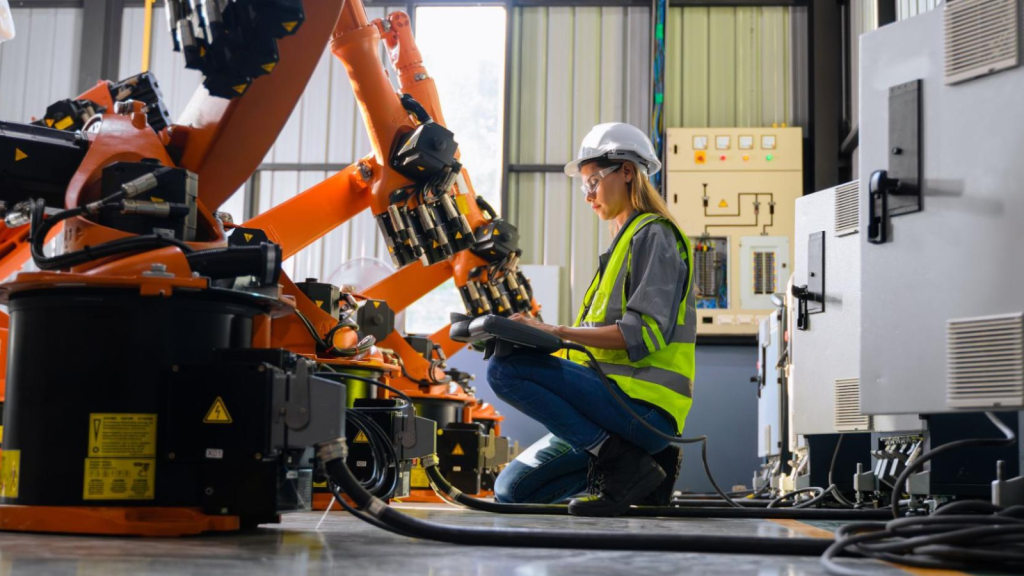
Opinions expressed by Digital Journal contributors are their own.
Inside an RV plant in northern Indiana, a curved fiberglass countertop that used to take an hour to hand-finish now leaves the line in six minutes. Sanding and polishing a complex surface to a uniform sheen had long resisted autonomous finishing, and for a counterintuitive reason: the variation inherent in geometry and surface condition made it the hardest job on the floor to teach a machine. By 2023, more than four million industrial robots were operating on factory floors worldwide, according to the International Federation of Robotics’ World Robotics report. While CNC machining handled the cuts and robotic assembly handled the bolts, surface finishing held out longer than either of them.
The floor’s last rule: Hands only
Every autonomous process on a factory floor follows a predetermined path:
- A weld traces the seam an engineer drew
- A mill follows the tool path a CAM system generated
- Even bin-picking, long the benchmark problem for difficult autonomous applications, became tractable once vision systems learned depth perception
Surface finishing has no such path. Part geometry and material thickness vary. The surface flaws on any given part, such as a small ridge left by a mold or a soft spot in the gel coat, also vary from piece to piece. A skilled finishing operator senses pressure through the wrist, hears the tone of the abrasive shift, watches resin dust change color as it heats, and adjusts continuously. That kind of real-time adaptive judgment can’t be reduced to a routine written months earlier in an engineering office.
GrayMatter Robotics, a Physical AI company building Factory SuperIntelligence (FSI) for manufacturing, deploys autonomous finishing cells designed for exactly that constraint. Where software AI systems learn from internet data, Physical AI systems operate in and learn from the physical world. GrayMatter Robotics’ autonomous finishing cells draw on ATLAS, the company’s proprietary data regime comprising 7 petabytes of real-world surface finishing data accumulated across 30 million square feet, 20-plus industries and 11-plus sensing modalities. That foundation develops Process Intelligence, the learned understanding of how tools, materials and surfaces interact under real manufacturing conditions, enabling the system to adapt in real time to whatever geometry and surface condition the part presents, without pre-programming. The result is closer to what a craftsperson does than to what a conventional robot does.
The craft behind the calluses
A traditional finishing apprenticeship begins with feel. The early months are less about technique than about calibration: learning how the body interprets pressure and how the same motion produces different results under different conditions. Apprentices learn abrasive selection and progression. They learn how a given resin responds to heat and how ambient humidity affects how a coating lays. That education has genuine value, but it requires four to six months to reach a productive level and years to reach mastery. In a labor market where manufacturing competes against every sector for the same generation of workers, that timeline is increasingly difficult to sustain.
“Surface finishing has always been treated as an art, something you learn through years of practice. But it is physics, and once you model it correctly, you can build systems that learn and adapt in ways that traditional robots can’t,” said Ariyan Kabir, Co-Founder & CEO of GrayMatter Robotics. “The breakthrough for us came when we realized that the skill operators develop over years is really their internalized understanding of physics in action. Encode that physics in software and you can deploy that capability anywhere.”
Autonomous finishing cells change what operator training needs to produce. Workers who once required deep manual craft now need systems fluency, the understanding of what the machine is doing and why, rather than the physical capacity to replicate it.
Five jobs gone, or five jobs changed?
The arithmetic that initially looks like subtraction often resolves differently. When a single autonomous cell handles the work that previously occupied six finishers, the instinct is to read that as five positions eliminated. In practice, facilities that deploy these systems tend to expand rather than contract. The throughput gains that justify autonomous finishing are the same gains that make it possible to take on volumes previously out of reach. Two or three cells running in parallel require upstream support and operational oversight the prior headcount wasn’t providing. The floor is busier, not quieter, and the roles shift accordingly.
A second force is accelerating this transition. CAD and CAM tools have made it cheaper to design parts with curves and undercuts that an engineer would have avoided a decade ago because no one could finish them consistently at volume. Research published in Materials found that conventional CNC machining strategies relying on fixed step sizes are inherently inefficient for surfaces with rapidly varying curvature and that aligning tool paths to local surface geometry reduced form error by 48.4% in a single pass.
Facilities still relying on manual finishing are quietly discovering that the geometry coming out of engineering has outpaced what a human finisher can produce consistently at scale. Geometry-agnostic autonomous systems convert that pressure into a competitive advantage. The complex surface that once represented a bottleneck becomes another part moving through the queue.
FAQs
1. Why has surface finishing resisted autonomous solutions longer than other manufacturing processes?
Every other major manufacturing process follows a predetermined path, but surface finishing doesn’t. Geometry variation is the primary factor: no two parts present exactly the same surface, and materials behave differently under heat and pressure. Surface flaws vary part to part, and pre-programmed systems that execute fixed instructions lack the continuous adaptive judgment that finishing requires.
2. How do vision systems enable robots to adapt to different part geometries?
Vision systems allow autonomous finishing cells to read each part’s actual geometry in real time rather than executing a path written to a CAD model. Because part dimensions vary within normal manufacturing tolerances, a system that adapts to what is physically present rather than what the drawing specifies handles geometry variation and surface irregularities without manual reprogramming between parts.
3. What integration challenges should manufacturers expect when adding autonomous finishing to existing production lines?
The most common issues involve floor space allocation, electrical and pneumatic capacity, and workflow sequencing. Autonomous finishing cells are designed as standalone stations that fit into existing layouts without requiring line redesigns. Most facilities run autonomous and manual processes in parallel during an initial validation period before transitioning fully.
The factory floor’s last manual process gets an AI upgrade
#factory #floors #manual #process #upgrade